STARLING is a monthly electronic missive co-authored by Özge Serin and M Acuff. You’re receiving it because we thought you’d like it. Our desire is to craft a series of short offerings, of things we’re into, have found enthrallment with, or are just mulling over. Our musings engage with things new and old, local and at a far remove, spatially and temporally; against the daily deluge of stimulus these are a few items we are holding close.
This name STARLING implies a community of synchronous correlated intelligence and more-than-human wisdom, which we are imagining into being.
We hope you will enjoy!
On Peet’s Peaks:
Over the last few years I have acquired 3 prints made by the artist Kyle Adam Kalev Peets, all of which depict mountains. The verb “depict” comes from late Middle English and from the Latin verb, depingere, de- ‘completely’ + pingere ‘to paint’. Completeness is a curious notion in relation to representation; a “complete” image suggests the errant possibility of incompleteness…
But, a mountain, of course, lacks nothing.
What instead could be found lacking? A quality of reverence? A faulty faculty of perception of mountainness itself? Surely, surely. Peet’s mountains shoulder this representational burden. In a recent installation, these peaks have been made to stumble and stretch across an entire gallery wall. A single image repeats; the mountain skitters and trembles in a manic lateral and duplicating dance. I’ve never seen a mountain multiply before. By Peet’s humble human hands I’m made aware of the complete incompleteness of my gaze.
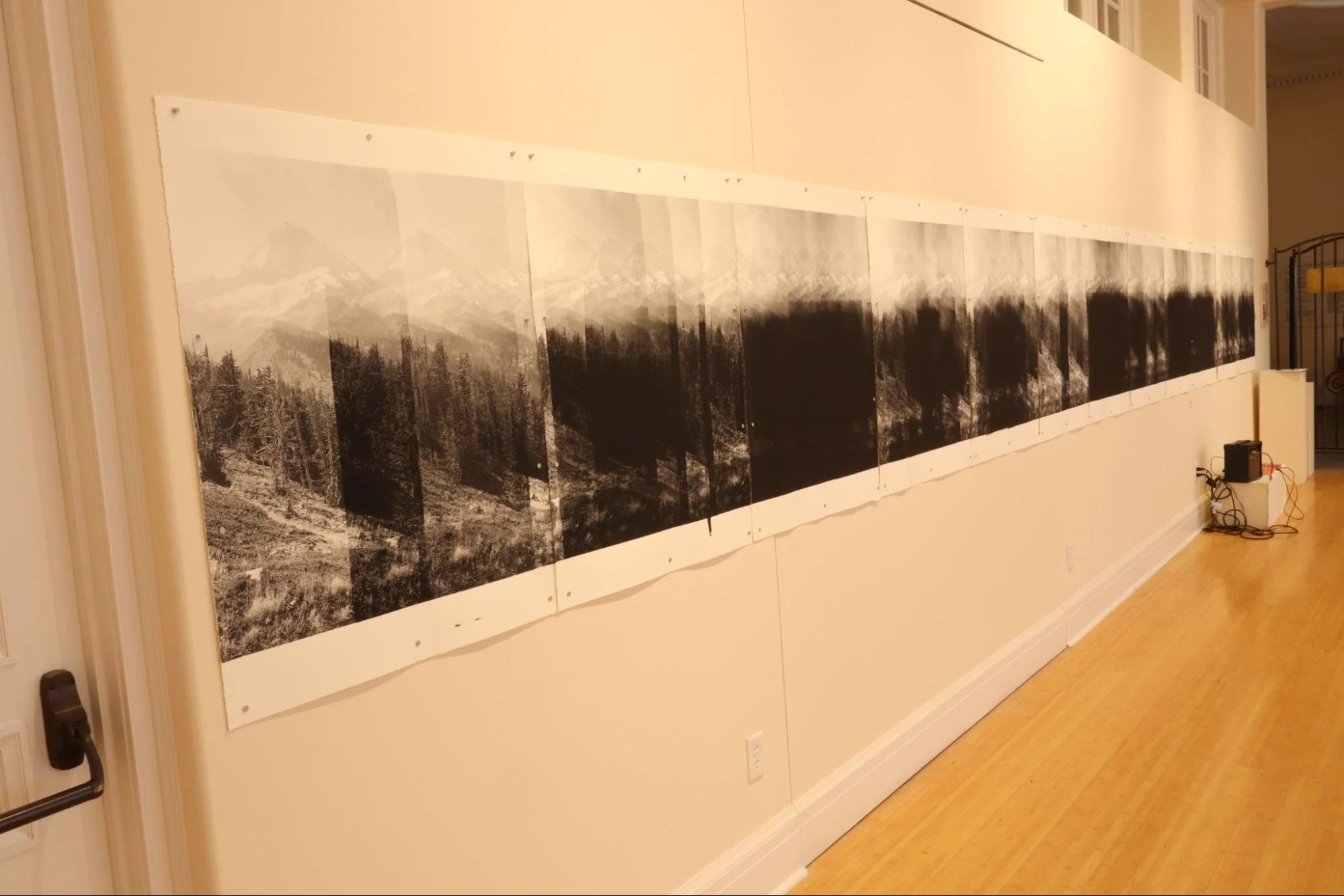
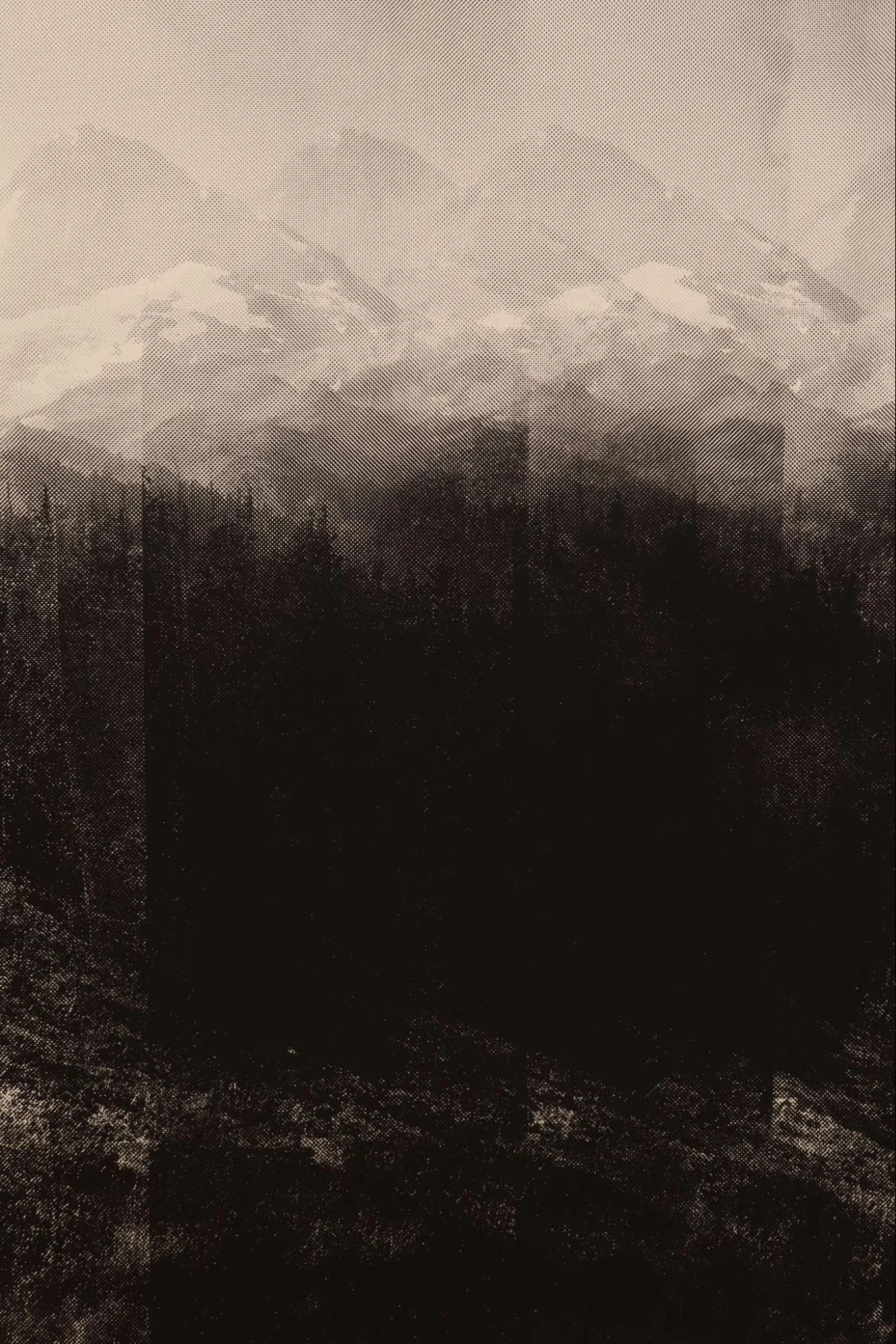
Screenprint monotype, 26x24.5”, 2026 (individual print and installation view at the Pendleton Center for the Arts)

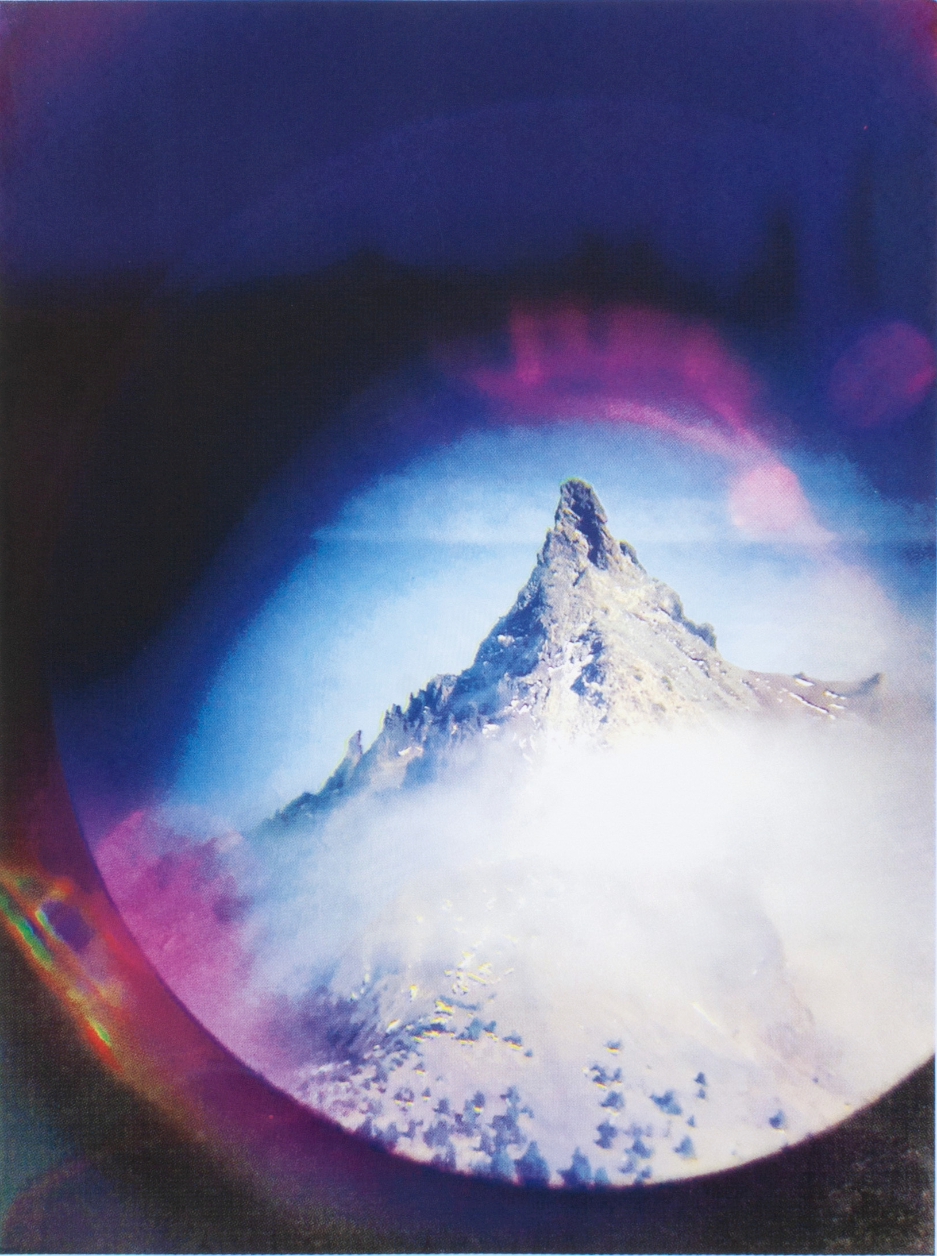
Still in Search of the Miraculous (Thielson),
4-color CMYK screenprint, 26x34.5”, 2021
Reverie #1:
In "Fear of Breakdown," a brief paper written shortly before his death, D. W. Winnicott (1974, p. 104) offers what he calls a "queer kind of truth": the fear of breakdown is the fear of a breakdown that has already happened. The feared breakdown is thus not simply a future catastrophe ahead of us but one behind us—a breakdown that has already happened and yet was never experienced as such. Unlike Freud’s Nachträglichkeit, or deferred action, where an early event becomes traumatic only later, Winnicott names something stranger: not an event whose meaning arrives belatedly, but the failure of an event to occur at all—“nothing happening when something might profitably have happened” (p. 106). Winnicott's clinical insight is that something necessary failed to occur, leaving behind not a mnemonic trace but a gap in the infant's “going-on-being” before any self existed to survive it. Precisely because the breakdown was not psychically registered as an event, the dialectic of transference and countertransference in the analytic relationship does not work toward “remembering” but toward experiencing — for the first time, in the here and now— the “primitive agony”: the failure of the facilitating environment in that early state in which mother and infant were one, the gap in the infant’s continuity of being that was never registered because there was, as yet, no self capable of registering it. It is this gap that we compulsively seek and simultaneously dread. In search of what breakdown must we nevertheless go on living?
Stick Ceremony:
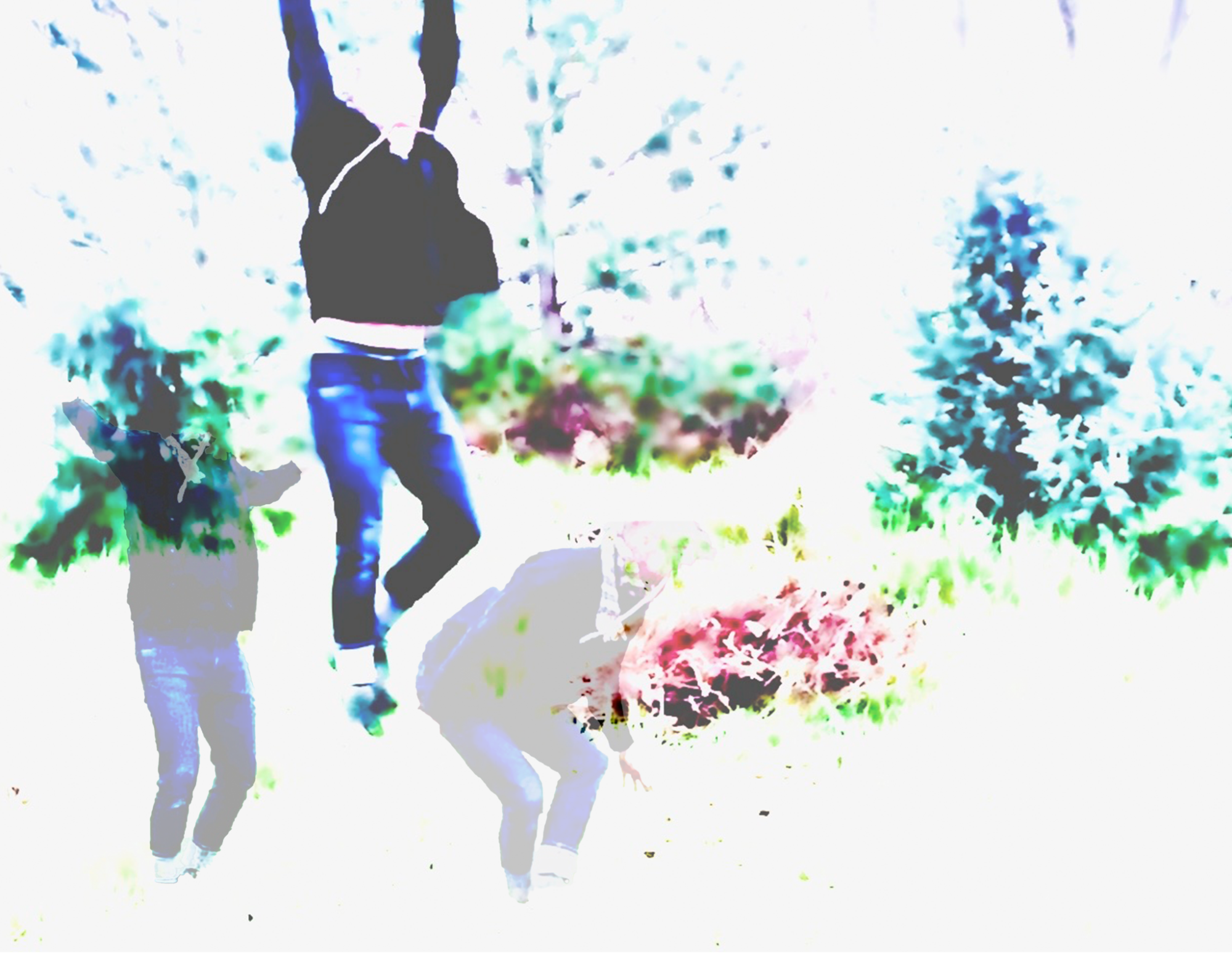
Above Mill Creek a siege of Great Blue Herons has established a heronry in a large tree adjacent to the trail where I take our pup Ruya on his daily afternoon walk. As spring nears, the herons pair off, mend their nests from winter ruination and grow increasingly vigilant. These are substantial, philosophical looking creatures with exquisite blue-grey plumage. In my favorite mating ritual–the Stick Ceremony, the male devotedly conveys a twig to its nest-bound mate. Drawing wide circles in the sky, stick in beak, the transition from flying to perching is a sight to behold. In order to hover, the massive bird’s wings pump and thrash in an unhinged, gravity defying spectacle, while their long legs extend down through precarious air in search of a branch. Once the heron settles and balances, the stick is transferred, from beak to beak, and then expertly added to the nest, in just the right location. See image below for M’s re-enactment:
Film of the Month - Au hasard Balthazar:
Robert Bresson's Au hasard Balthazar (1966) opens with a tenderness that the world of the film will not allow to last. The donkey Balthazar is baptized by children — Marie among them — who love him with the unselfconscious grace of the not-yet-worldly. That sojourn in innocence is brief. Balthazar passes into the hands of a succession of owners–some indifferent, most cruel. Marie passes into the human world through the loss of her childhood love. From that point Marie’s story and Balthazar's run alongside each other, delivered into a world ruled by men who are the true beasts — Gérard, who takes Marie by force, and the miller, who offers false shelter before trading her back to her parents like livestock. Predatory and falsely protective, they are the destructive and self-preservative faces of the same sovereign power over life.
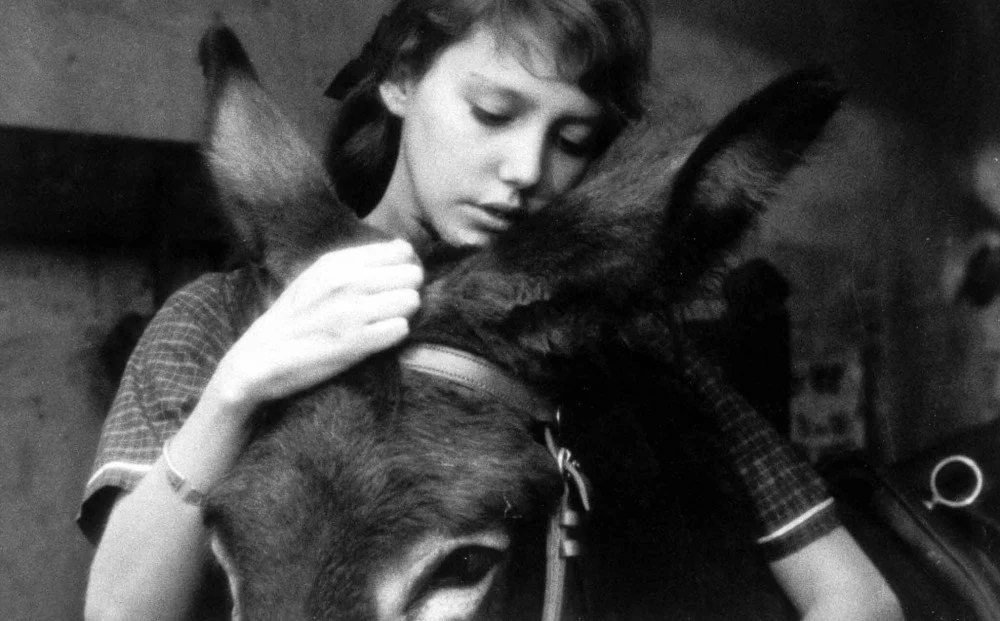
Film still, Au Hasard Balthazar, Robert Bresson, 1966, via Film Forum
What Bresson reveals between Marie and Balthazar is not simple analogy but a shared exposure. They are both beings perpetually au hasard, at large and at risk, directly captured by sovereign powers that exchange, exploit, wound, and abandon them.
For Italian philosopher Giorgio Agamben, sovereignty is not simply the king or the state but the "ban" on bare life — the elementary sweetness of living that can be destroyed without infracting any law and without being sacrificed. Yet Bresson does not dwell on the spectacles of exception; he attends instead to the minute, ordinary scenes of cruelty in which life is ground down: casual blows, petty humiliations, habitual indifference, the unremarkable violences that leave almost no mark and require no justification. It is this sweetness Bresson holds in view — the same the children brought to Balthazar at the opening — and it is this that the world of the film extinguishes, quietly, without ceremony.
Agamben argues that life is double: not dialectically split between higher and lower forms, but critically split between zoē, ‘‘the simple fact of living common to all living beings,’’ and bios, ‘‘the form or way of living proper to an individual or a group” (p. 5). Human life is defined not by its mastery of this split but by its unresolved relation to its own passive, non-speaking animal existence it can never leave behind. Balthazar's braying is not speech, yet not mere noise; his gaze is not human, yet not simply opaque. Marie and Balthazar do not symbolize one another's condition. They touch each other within it — unlike Gérard's grabbing hands or the miller's falsely sheltering ones, Marie's hand on Balthazar claims nothing, makes literal what the film enacts at every level: a contact between lives at the point where the human and the animal are no longer securely divided.
The circus scene near the end is the first moment the film steps outside the human world entirely. Passing among the tiger, the polar bear, the monkey and the elephant in cages — animals without proper names — Balthazar seems to enter for the first time a circuit of recognition unmarked by ownership or abuse. The reciprocal gaze between the animals, held and intensified by the camera, fleetingly suspends everything the human world has imposed on them. There is no human presence to anchor meaning, only the camera transfixed before that extrahuman exchange.
The final scene is even more haunting. Gérard's gang uses Balthazar one last time — to carry contraband across the mountains at night — then abandons him in the crossfire. By morning he is alone on the hillside, bleeding, his wounded flank catching the light. He wanders, slows, and sinks down among a flock of sheep. Their bells, recurring throughout the film, ring around him like an accidental funeral liturgy. There is no human witness, no imposed meaning, only the flock, the hillside, the sound, and then stillness. Marie, too, has by this point disappeared — abandoned by a world that will not mourn her passage through it. The two endings rhyme without quite touching — each unredeemed, each spent, leaving no residue of meaning or recognition. What makes Balthazar's death so intolerable is precisely the gentle indifference surrounding it: not cruelty, just the world continuing. Any grace in that moment belongs entirely to us the viewers, projected onto an animal with no access to it — which may be Bresson's most devastating suggestion of all.
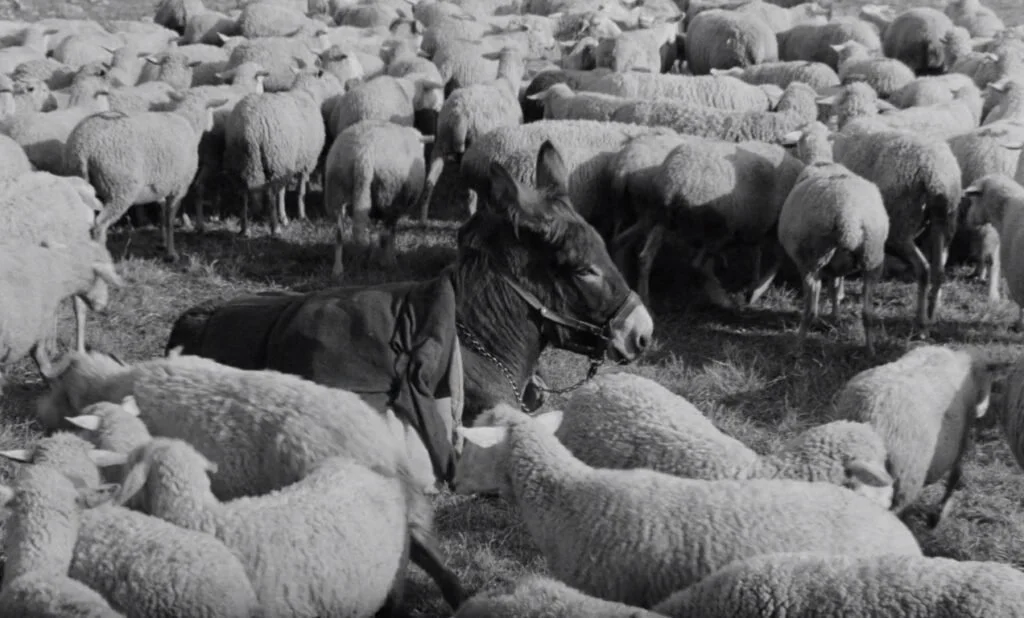
Film still, Au Hasard Balthazar, Robert Bresson, 1966, via Wrong Reel Productions
2+2=5: part of our practice in creating STARLING is to allow for the 4 things gathered here to spontaneously generate a 5th thing. This month’s 5th thing is a sculpture by Richard Serra:

Richard Serra’s To Lift, rubber, 1967
Download the PDF of STARLING attached to this email.
Send STARLING to a friend!