M Acuff + Özge Serin

STARLING is a monthly electronic missive co-authored by Özge Serin and M Acuff. You’re receiving it because we thought you’d like it. Our desire is to craft a series of short offerings, of things we’re into, have found enthrallment with, or are just mulling over. Our musings engage with things new and old, local and at a far remove, spatially and temporally; against the daily deluge of stimulus these are a few items we are holding close.
This name STARLING implies a community of synchronous correlated intelligence and more-than-human wisdom, which we are imagining into being.
We hope you will enjoy!
Becoming A Slow River:
She said standing next to him was like standing next to ”a slow river”. He’d done his spiritual work…and then some. Water-moving-effortfully-across-stone. Calm, deliberate, earth-hugging, liquidy passage. A steadfast kind of presence; he was a slow river gently donkeying his way to the sea. A display of emotional equilibrium unlike any she had encountered before.
My question: Could I learn to become one too? If so, how? Since then, I’ve been developing Practices for Becoming a Slow River:
#1 Amble quietly near a river or creek. Caress the closest rocks with the fully outstretched palm of your hand. Yield sweetly to their shapes. Notice your body grazing their bodies. Marvel at their coolness or warmth; be unbridled in your affections.
Film of the Month — Werckmeister Harmonies:
With gratitude to Daniel, Xiaobo, Yuki and Michael, in whose company we first watched this film
The late Béla Tarr’s Werckmeister Harmonies (2000), adapted with Ágnes Hranitzky from Nobel Prize-winning writer László Krasznahorkai’s novel The Melancholy of Resistance, is among the strangest and most haunting films I have watched, its images at once ravishing and severe. The film compresses seven and a half hours of footage into thirty-nine long takes, unfolding in a small Hungarian town in late winter, where a circus arrives hauling a dead whale sealed in a metal trailer and a riot empties the streets by morning.
The film opens in a provincial pub at closing time. János Valuska arranges a group of drunk, worn-out men into the bodies of the cosmos — sun, earth, moon — and walks them through an eclipse. Through these staggering human bodies, he tries to enact a pattern of perfect proportion — the slow, geometric rhyme of celestial bodies. For a few minutes, against everything, the cosmic ratio almost sounds with Mihály Vig's slow, descending theme. Then the pub owner shuts it down, and the fragile cosmos collapses back into lurching bodies in the room.
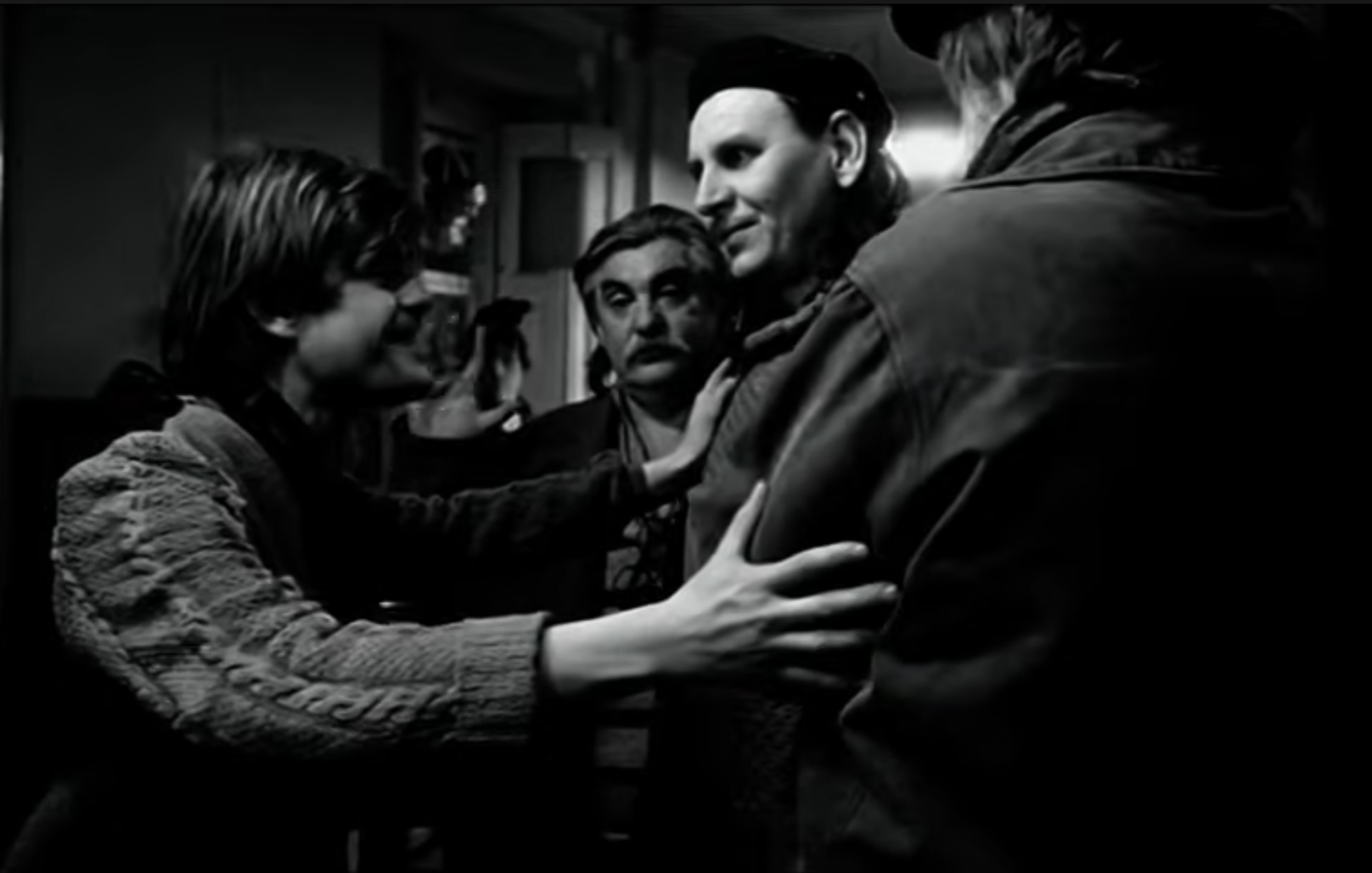
Screenshot via Aldimitris, watch the opening scene here.
The film's title names a forgotten chapter in the history of Western music. Andreas Werckmeister, a 17th-century German music theorist, proposed a solution to a problem the ancients had treated as cosmic. Two notes "rhyme" when their vibrations stand in a clean whole-number ratio: an octave is 2:1, a fifth is 3:2. These are not arbitrary aesthetic preferences but the same proportions hidden inside the overtones of every vibrating thing in nature. To hear two notes in clean ratio is to hear the universe rhyme with itself — what the Greeks called the music of the spheres.
The trouble is that pure intervals do not, as a system, fit together. Twelve successive perfect fifths should return, seven octaves higher, to the note from which they began; instead, they exceed it by a small remainder the mathematics cannot eliminate. Older tunings preserved most intervals by forcing this error into one or two unusable “wolves”, so harshly out of tune that the notes seemed to growl against each other. Werckmeister’s solution was to temper the tuning: bend each interval slightly off its pure ratio and distribute the error across the system, so that no interval rings perfectly true but every key becomes usable. The compromise eventually came to sound like music itself. Pure intervals survived only in voices and bowed strings, where pitch could still be adjusted in real time, while the tempered system became the floor everyone forgot was a floor.
György Eszter, the film's withdrawn musicologist, is the one figure in the town who has not forgotten. He has heard the lie at the foundation of every chord, and his response has been a long, patient retreat from sounding altogether. He sits in his house in shirtsleeves working at a small piano he means to retune to some pre-Werckmeister system that would restore the pure intervals the world traded away.
The crucial point — the one the film hinges on — is that two bodies may rhyme freely when their vibrations fall into pure ratio, but an entire network of bodies cannot rhyme purely with one another all at once. The pure ratios are plural and mutually incompatible across a system. To build an ensemble of many bodies, one must temper. Each relation must give up a little of its purity; the impurity must be distributed across the whole, so that no individual interval rings fully true, but the system as a whole holds.
Tarr’s town is this kind of tempered ensemble, rendered with extraordinary sparseness: not a dense fabric of relationships but a sequence of ordinary tasks and minimal contacts, many of them routed through János. The few dyads that flicker into view are not pure intervals but closed pairings and groupings, rhyming only with each other and excluding everything around them: the kissing couple in the soup kitchen, Tünde and the police chief in their grotesque dance, the chief’s children at raucous play in the apartment. Eszter, in his shuttered house, is the limit case: a withdrawal so total that the question of rhyming with anyone no longer arises.
János moves among these sealed relations, carrying messages, observations, attention. He rhymes outward with the town’s bodies, upward to the cosmos and downward to the deep. When János comes to the open back of the trailer, his eye meeting the whale’s huge dim eye in the sealed dark, what passes between them is the film’s secret: not knowledge, not recognition, but a regard held in pure ratio across the silence imposed on the singer by its extraction from the depths of the ocean. Whales are among the great vocalists of the planet, sounding across vast distances in frequencies the human ear can barely register unaided. For an instant, the deep becomes audible in a town that has lost the capacity to hear it.
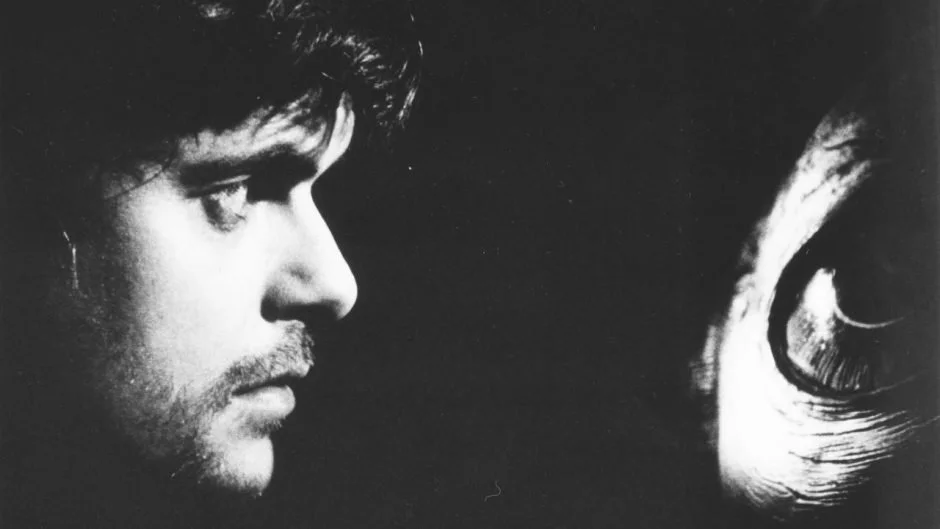
Film still, Werckmeister Harmonies, 2000
The Prince, who travels with the whale, is the dark inversion: not a body moving through the town, but a disembodied voice—broadcast, translated, glimpsed only in shadow—that gathers the town’s dispersed bodies into a mob. The aligned mob, drawn by that voice, marches in silence through the empty streets to the hospital and begins, methodically and without speech, to break everything they find. The hospital sequence stages two unbearable encounters with the limit of perception. János, hidden, watches the mob move through the wards beating patients in their beds. His pure perception, open to what is at its actual ratio, is now being asked to receive the wolf interval— pure violence at full volume. His pure eye, having no tempered cushion, breaks. By the time we see him again he is in a hospital bed, eyes open and unblinking, gaze emptied. He has become the whale: the witness who saw to the bottom and cannot speak, joined now to the order of those whose knowing is total and whose testimony is constitutively impossible.
The mob, in the same sequence, encounters its own limit. They pull aside a curtain in the shower and there stands a naked, emaciated old man — and they stop. What halts them is not a recovery of conscience. It is a powerlessness so absolute, so undisguised, that any blow against him would have to know itself as violence, with no resistance to absorb its meaning, no enemy to confirm it. Faced with sheer defenselessness it cannot metabolize, the violence loses its hold. The men turn and leave.
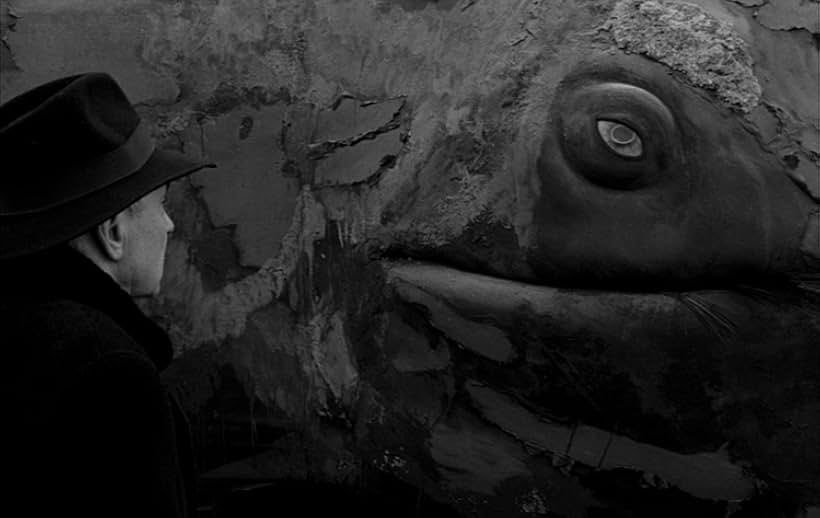
Film still, Werckmeister Harmonies, 2000
By the end, Eszter walks alone to the wreckage of the whale lying in the empty square. The man who had withdrawn from the tempered world rather than add another false note to it now arrives before the carcass of the only being in the town that had ever rhymed with the cosmos he was mourning. The eye of the whale, the eye of the broken János in his bed, the eye of Eszter finally consenting to look: three witnesses, only the third still capable of testimony, and only to a wreckage. The camera is the film's only true witness. It circles bodies, climbs to the sky, descends into the dark of the trailer, holds every surface in a single regard. It sees what no human eye can see at once and does not break. For two and a half hours we are lent this regard. Then the film ends, and we walk back into the tempered light.
Reverie #2:
D. W. Winnicott returns, or I return to him. Last month I sat with his late essay on fear of breakdown; this month I find myself returning to an earlier piece, "Communicating and Non-Communicating Leading to A Study of Certain Opposites," and to a passage that seized me immediately.
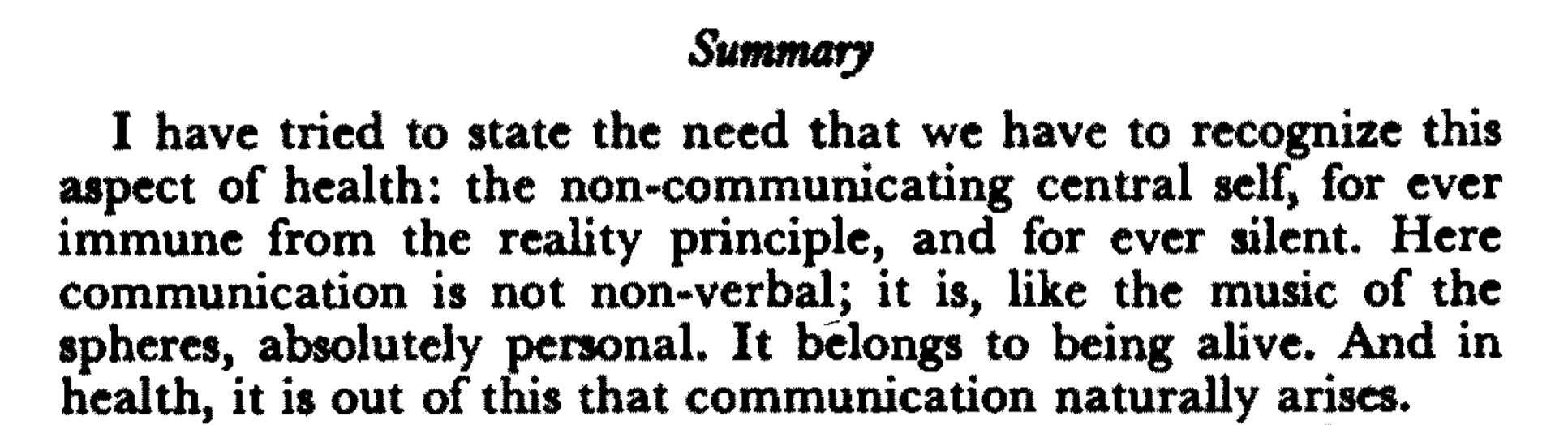
Winnicott’s phrase — “like the music of the spheres, absolutely personal” — sends me to Agamben’s reflections on impotentiality. Reading Aristotle, Agamben insists that potentiality is not exhausted by its actualization; to be capable of speaking also means to remain capable of not speaking. To speak is not to actualize a potential but to hold open a relation to silence: I speak insofar as I do not remain silent. What we cross when we speak is not a system but a passage, from singular body to speaking subject. The singular voice — its pitch, timbre, cadence — is a threshold. What Winnicott guards at the center of the self is precisely what that passage cannot carry across: the silent, incommunicable aliveness from which communication nonetheless arises.
Postscript. Only later did I realize that Winnicott had been sounding, all along, beside this month’s film. The coincidence was not coincidence: something in me had been circling the same question across both, without my knowing.
Miller Oberman’s The Centaur:
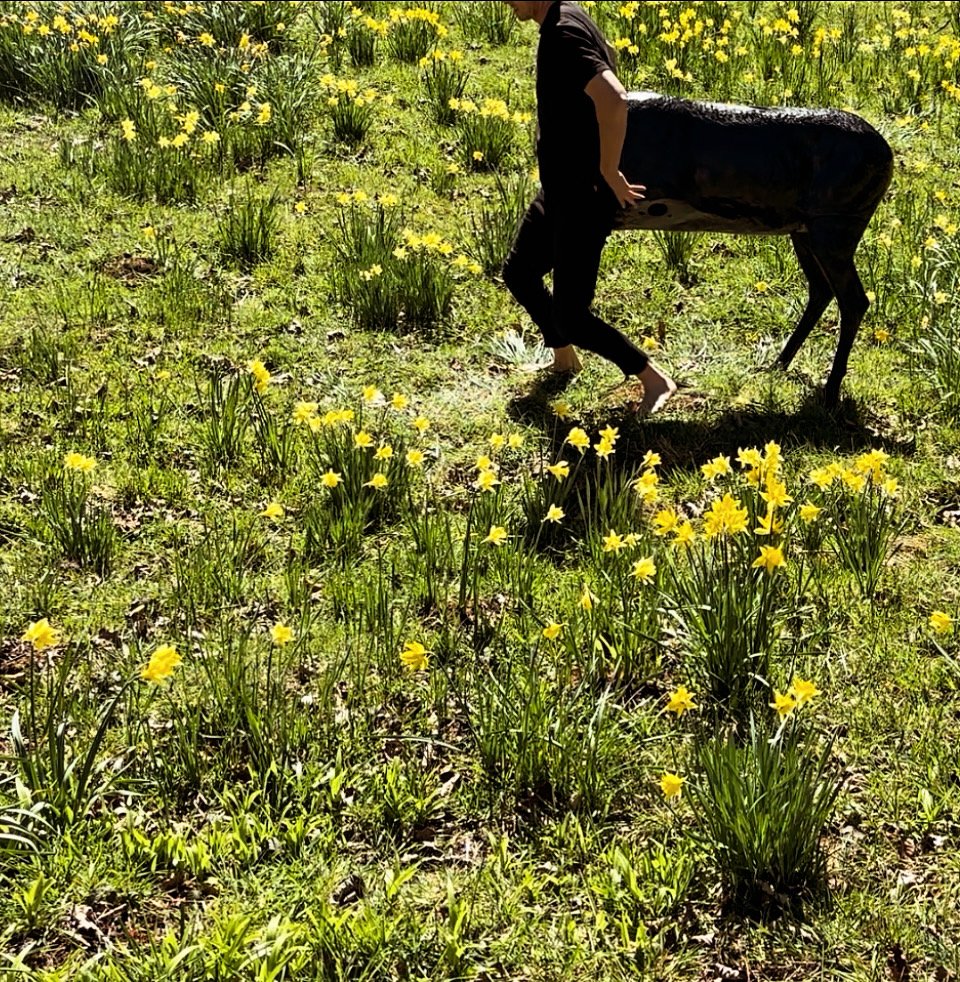
Performance still made at The Sitka Center for Art & Ecology, Otis, OR 2023
2+2=5: part of our practice in creating STARLING is to allow for the 4 things gathered here to spontaneously generate a 5th thing. This month’s 5th thing is this mesmerizing video from the Royal Society featuring Dr. Ellen Garland explaining her whale song research and discoveries.

Still from The Royal Society, video here.
Send STARLING to a friend!