M Acuff + Özge Serin
STARLING is a monthly electronic missive co-authored by Özge Serin and M Acuff. You’re receiving it because we thought you’d like it. Our desire is to craft a series of short offerings, of things we’re into, have found enthrallment with, or are just mulling over. Our musings engage with things new and old, local and at a far remove, spatially and temporally; against the daily deluge of stimulus these are a few items we are holding close.
This name STARLING implies a community of synchronous correlated intelligence and more-than-human wisdom, which we are imagining into being.
We hope you will enjoy!
The Council of the Mother Spirits of the Animals by Cecilia Vasquez Yui:
La Biennale di Venezia
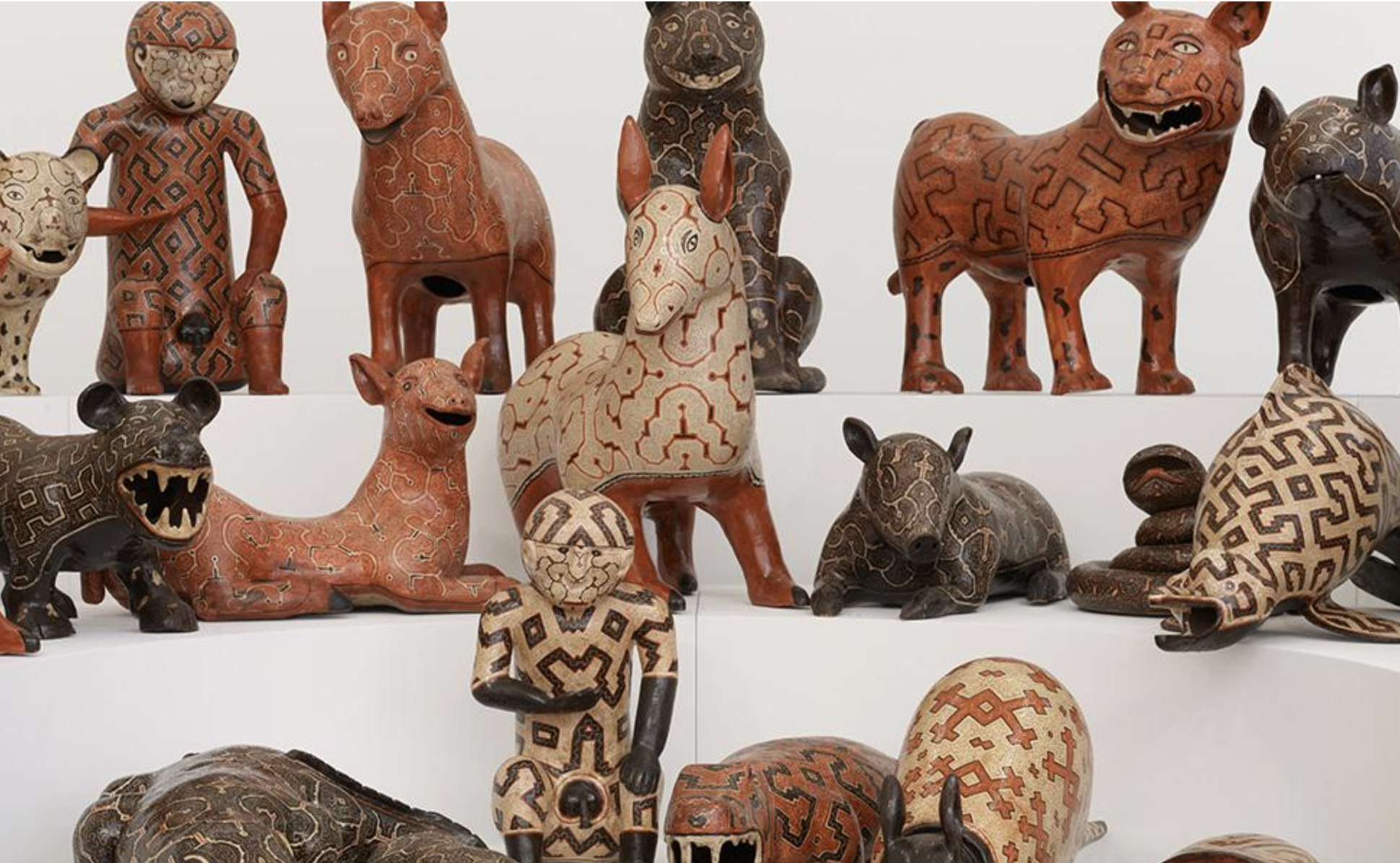
I was brought to my knees (quite literally) and stunned into silence upon encountering this multiverse of 50 wise and fierce clay-bodied creatures at the Venice Biennale recently. Seated on a concentric semicircular set of raised platforms, this menagerie of animal-shaped spirits is outfitted in grimaces, toothy smiles, wing-ed and leggy congeniality. They are unanimously decorated in elaborate surface designs redolent of labyrinths, the floor plans and facades of cathedrals, and other urban topographies—sacred geometries all. Collectively they manifest a spectrum of expressions ranging from startled, silent, plaintive, coiled, wide-mouthed and beaked, to contemplative, sure-footed, and tentative. They are bound and birthed by a shared tellurian signature, wrought by the hands of artist Cecilia Vasquez Yui with the clays and glazes of the Ucayali River basin, in the Upper Peruvian Amazon.
These beings are absolute in their attentiveness. Full-bodied attention like this literally means showing up, serving, caring for. For Barry Lopez, attendance is not just being here: it’s sticking with being here until a connection is formed. In attendance, Lopez proffers, “loneliness is transmuted into connection, that which was broken is made whole.”
Would that it could be so! And possibly it is: the visual language inscribed all over the assembled animal surfaces is called kené, and is one that Vasquez Yui, a member of the Shipibo people, wields with Lopez’s curative precision. These geometric patterns are believed to invoke subtle but deep changes in their viewers, functioning as a kind of ‘design medicine’.1
“In mythic times these patterns covered everything—the sky, trees, huts, people, animals, et cetera—in a continuous tissue of design. But due to the misdeeds of failed protohumans, this idyllic union ruptured and differentiated into floating, superimposed planes: Nëtë ŝhama (the sky world), Mai (the earth world), and Jënë ŝhama (the subaquatic underworld). Simultaneously, periodicity (day and night, or time), mortality, and speciation appeared. And the geometric lineaments ruptured. Now they appear only on specific design fields, such as the upper parts of fineware pottery, people’s faces, or the blades of war clubs. All these designs are pre-existent; the artist has only to grasp and fix them in her mind (shinan picotai, “the thoughts emerge”), lay them over the design field, and cut where they match that field, letting the rest of the design fade back into invisibility. The visible design remains as a window into the vast reticulate intricacy of the universe.”
—Peter Roe, University of Delaware; and Bahuan Mëtsa (Manuel Rengifo Barbaran, Shipibo), knowledge keeper, San Francisco de Yarinacocha National Museum of the American Indian
It is said that the lacey visual patterns that adorn Shipibo ceramics are the result of shamanic journeying in hallucinogenic ayahuasca ceremonies. Anyone with a basic exposure to art history knows that these and like patterns appear in Gothic, Aztec, Baroque, Islamic, and Romantic art and architecture the world over. Vasquez Yui’s congress of animal psychopomps are not only attentive, present, witnessing, nor are they simply a fantastical plethora of appendages and protuberances—paws, feathers and scales, oh my! They are also cloaked in the deep substrate, the immutable and medicinal design fabric of the multiverse. The Council of the Mother Spirits of the Animals proffers inordinate and many-headed communion with powers summarily earthy, beastly and sublime.
1 Matteo Norzi, Venice Biennale website
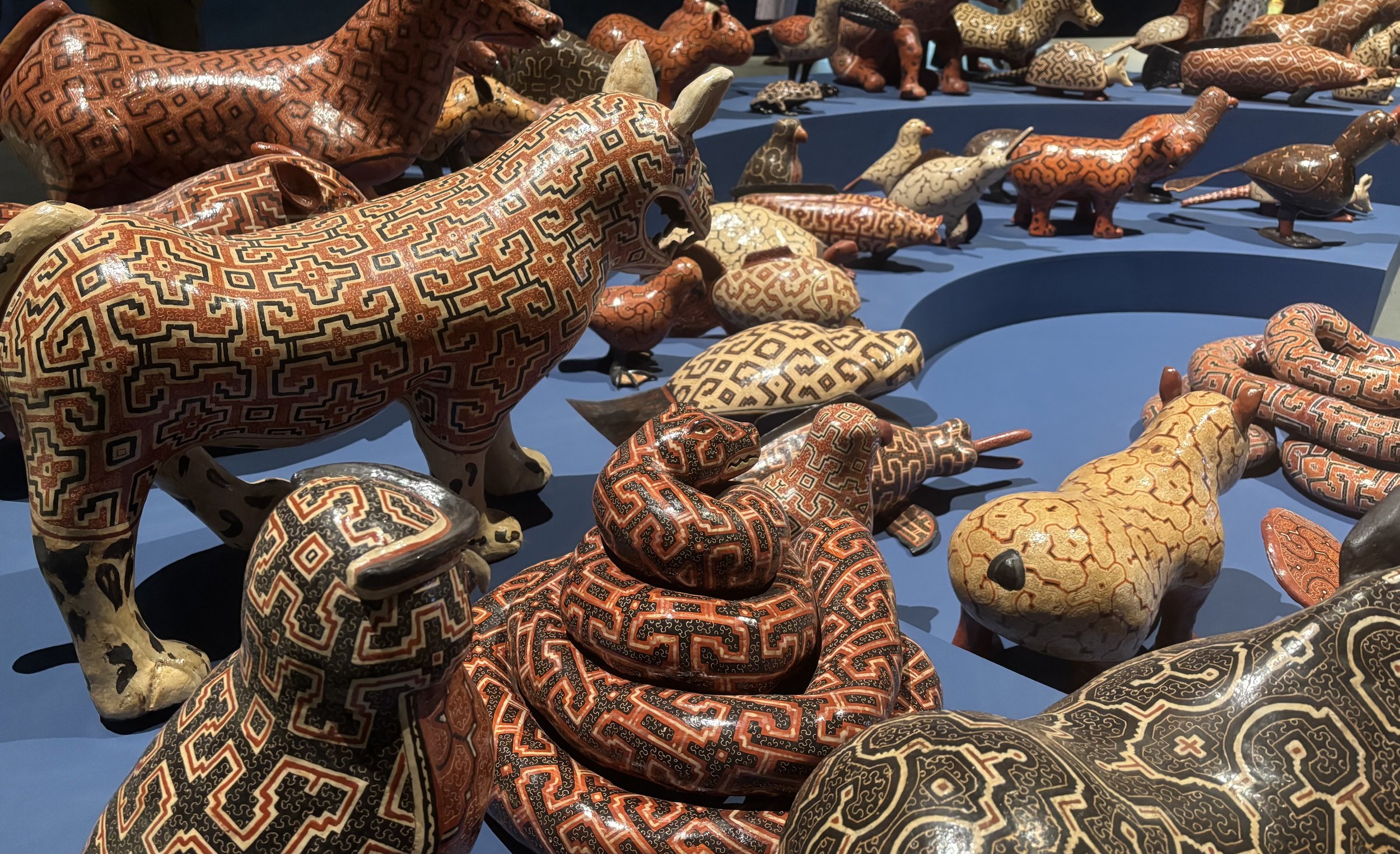
detail, The Council of the Mother Spirits of the Animals, Cecelia Vasquez Yui, Venice Biennale, 2026
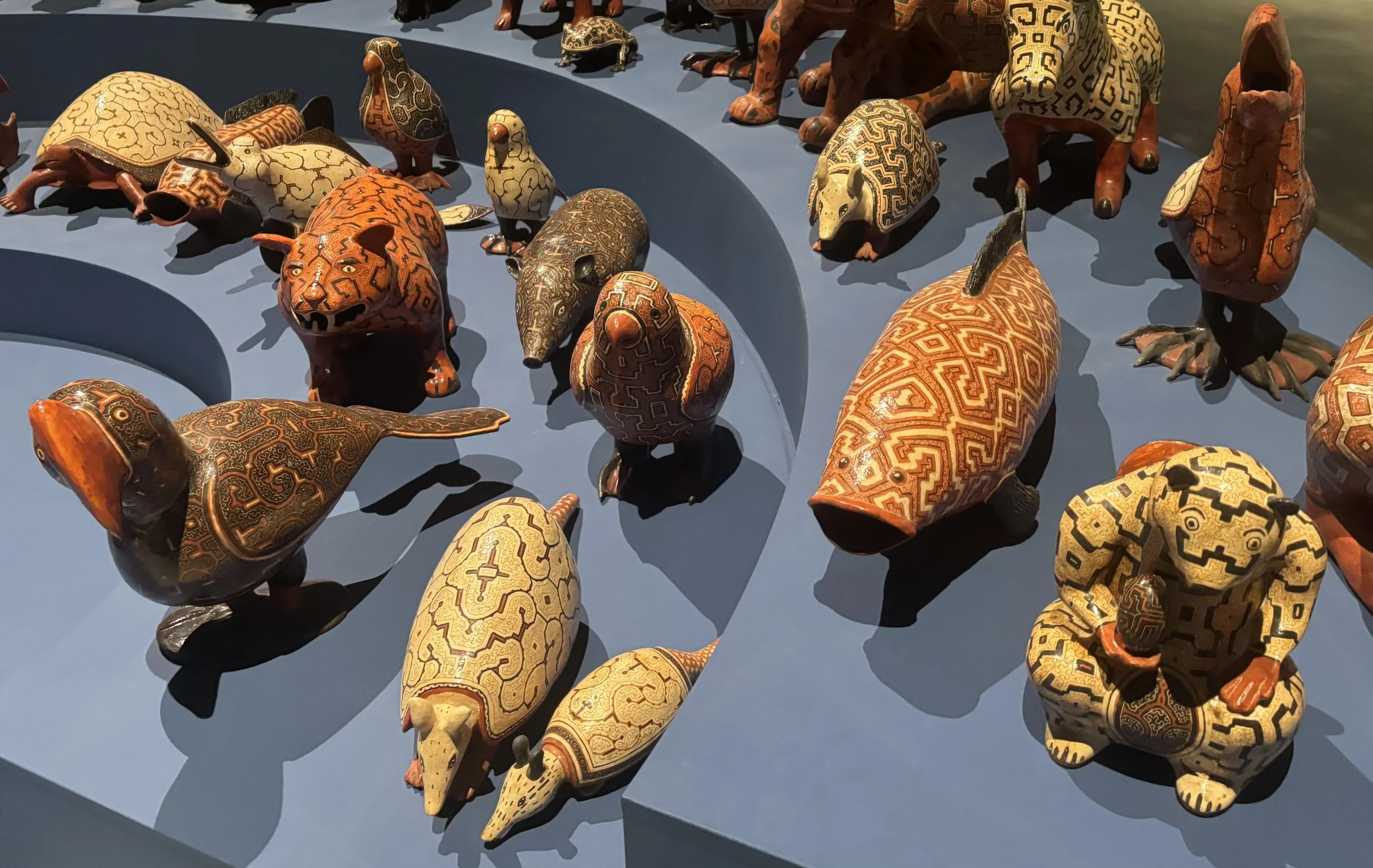
detail, The Council of the Mother Spirits of the Animals, Cecelia Vasquez Yui, Venice Biennale, 2026
Reverie #4 Le corps utopique:
I took such pleasure in listening to the radio broadcast in Foucault’s own voice and reading Le corps utopique in the French original. I found myself carried by the cadence of the text — by its hesitations, reversals, and the strange tenderness with which it returns to the body after first condemning it. The analysis that follows stays close to that movement, perhaps longer than necessary, because part of what I wanted to preserve was the pleasure of being led by the text itself.
In December 1966, in the wake of Les mots et les choses, Foucault delivered two short radio texts on France-Culture: Les hétérotopies and, two weeks later, Le corps utopique. The second has been easier to forget, overshadowed by the book with which it was contemporary, though it is the stranger text and, in some ways, the more revealing. It was not an improvisation but a composed text, written for broadcast and interleaved with literary reading. Its governing operation constitutes the body by unsaying it. It lays down a proposition about the body and revokes it, advances the contrary and revokes that in turn, in a movement properly called apophatic: a thinking that proceeds by negation, building its object out of the predicates it takes back. What it builds is a corps dédit: a body said and unsaid, retracted in the saying.
The first proposition is handed down like a sentence. The body is the one place that cannot be left behind: là où je suis, ici irréparablement, jamais ailleurs. Foucault states this as a verdict against the body, and the language is carceral: the body is topie impitoyable, a cage, a grille, a skin under which one is condemned to languish. Utopia, on this first telling, is everything the body is not: the dream of a body without a body, luminous and weightless, invented to be rid of the flesh one cannot escape. The utopias pass in procession, from fairyland through the cities of the Egyptian dead to the soul, each a machine for making the body disappear.
What overturns the first verdict is not a counter-argument but an act of attention turned back upon the body itself. The body proves already to harbor the contradictions that utopias were invented to supply: at once penetrable and opaque, visible and invisible, light enough to be traversed without resistance by every intention, until pain arrives to turn it into dead weight, a ruined architecture. There was no need of magic, soul, or death; il suffit que je sois un corps. And so the verdict is reversed: the utopias were not turned against the body but born from it. The body was the anti-utopia; the body is now the source of utopia. The figure is kept and its charge inverted.
This first retraction works through a binary that the talk lays down only to undo: inside and outside. Its first register is spatial. The surprise is to locate interiority not in an I set over against the body as a thing, but in the body itself, which is given an inner topology: cellars and attics, dark dwellings and luminous beaches, a head that is a strange cavern open on the world. This is the body as corps propre, in an idiom unmistakably belonging to Merleau-Ponty: at once absolutely visible and withdrawn into une sorte d’invisibilité, the back and shoulder one knows precisely and can never see except by the ruse of a mirror. Even here, the binary will not hold. The inside is open to a world that enters it; the visible outside keeps regions invisible to the one who lives it.
The mask, the tattoo, and the paint shift the register from the spatial to the ontological. The exteriority they introduce is no longer a matter of surfaces but of invisible forces: the body opened to gods, the sacred, desire; the body torn from its own space and projected into the space of an outside — exteriority in the sense Deleuze would later draw from Foucault, le dehors as a field of forces rather than a region of things. But the figures that follow undo even this second exteriority. The dancer dilated into a space at once interior and exterior, the possessed whose inside becomes hell, the stigmatized whose phantasm erupts as a wound: in these figures, the outside proves to have been the body’s own production. Exteriority, first posited as the body’s opening onto forces beyond it, is unsaid as the body’s own utopian power turned against itself.
Only once the outside has been shown to be the body’s own can the body be declared not merely here but always elsewhere. That second retraction is the talk’s vertiginous center. Having called the body an irremediable ici, Foucault now calls himself a fool for it: the body is toujours ailleurs, bound to all the elsewheres of the world, and indeed ailleurs que dans le monde. It is the zero point from which near and far, above and below, radiate: nowhere in itself, yet the source from which every possible place appears. The body that was only here is the placeless place from which every here is dealt.
A clean reversal would stop there, with placelessness installed as the body’s truth. But the talk unsays placelessness in turn. The mirror and the corpse teach a child, and once taught the Greeks, that one has a body at all, a body with contour and weight, a body that occupies a place. The child’s case is the mirror stage in all but name: for more than a year there is only a dispersed body, limbs and cavities and orifices, a corps morcelé that prend littéralement corps only in the image the glass returns. The Homeric Greeks, lacking a word for the body’s unity and keeping one only for the corpse, fight before Troy as raised arms, brave chests, and agile legs that never gather into a body. What mirror and corpse give, in both cases, is a unity the body does not possess on its own.
That borrowed unity recasts the rage the talk now names. The placeless condition that mirror and corpse quiet is no mere dispersal but a rage utopique that dilapidates and volatilizes the body à chaque instant — the corps morcelé under another description, the body that will not stay assembled, held in a single place only by the image that pins it. The Lacanian allusion is transparent, but Foucault borrows the mirror’s structure only to reverse its charge. For Lacan, the mirror’s unity is méconnaissance, an alienating armor to be seen through. Foucault makes the same image an instrument of appeasement. Morcellement is not mere lack but the body’s utopian power, its sovereign placelessness; the mirror brings not entrapment but repose. The same fragmented body, answered by the same image, is read once as trap and once as relief.
Placelessness, just affirmed as the body’s truth, has become the disorder that place must hush. And then this hushing too is unsaid. The mirror’s image lies in an inaccessible space; one can never be where one’s corpse will be; the two place-givers are themselves in an invincible ailleurs, so only utopias can close, for an instant, over the body’s deeper utopia. Place is returned to the body by other placelessnesses pressed into its service, and the return lasts exactly un instant — no longer than a rage that recurs à chaque instant will permit. The saying-unsaying has now run four beats: the body is here; the body is the source of utopia; the body is nowhere; the body is given back a place — and that place is borrowed from an elsewhere it can never inhabit.
Love is the third place-giver and the one on which the talk completes and exposes itself. To make love is to feel the body close upon itself, to exist at last outside all utopia, with its full density, entre les mains de l’autre. The here love confers is not recovered from within; it is delivered from the other’s position. The invisible regions — the nape, the back, the closed eyelids, everything the I can never reach — are made to exist for the first time by a hand and gaze not one’s own. And Foucault refuses to let this be redemption. Love, like mirror and death, appeases the body’s utopia, encloses it as in a box, la clôt et la scelle. The verbs are plainly funereal, the box also a coffin, and the kinship is avowed: love is close to the illusion of the mirror and the menace of death, flanked by these two perilous figures. The appeasement is built like a laying to rest.
Yet the final sentence is concessive, not funereal. Malgré these two perilous figures, one loves so much to make love because in love the body is ici. The peril is granted and kept, then overridden, and the reason offered is the single word that opened the talk. The body that began as ici irréparablement, the curse, ends as le corps est ici, the gift. The here of the ending cannot be a metaphysics of presence, because it is received from elsewhere, entre les mains de l’autre, and because it must be redone: one makes love, and loves to make it, against a rage that lifts the lid à chaque instant. A here that is local, repeatable, drawn from the other’s hands, holding nothing in reserve and winning nothing finally — and chosen, by the force of the malgré, against illusion and death.
Le corps utopique is less an argument with conclusions than a voice performing one gesture across a half-hour: it says the body and unsays it, gives it place and revokes the place, curses the ici and, at the last possible moment, blesses it. The apophatic texture is not ornament but the body’s own demand on thought: to be said only by being unsaid, given only through predicates it refuses to keep.
Pieta or What Does it Mean to Rely in Unfathomably Complex Ways on a Countless Number of Other Beings?:
Film of the Month - SIRĀT:
Spoiler Alert: This reading follows the film to the far side of its bridge. Every turn is discussed, including the ones that shouldn't be seen coming.
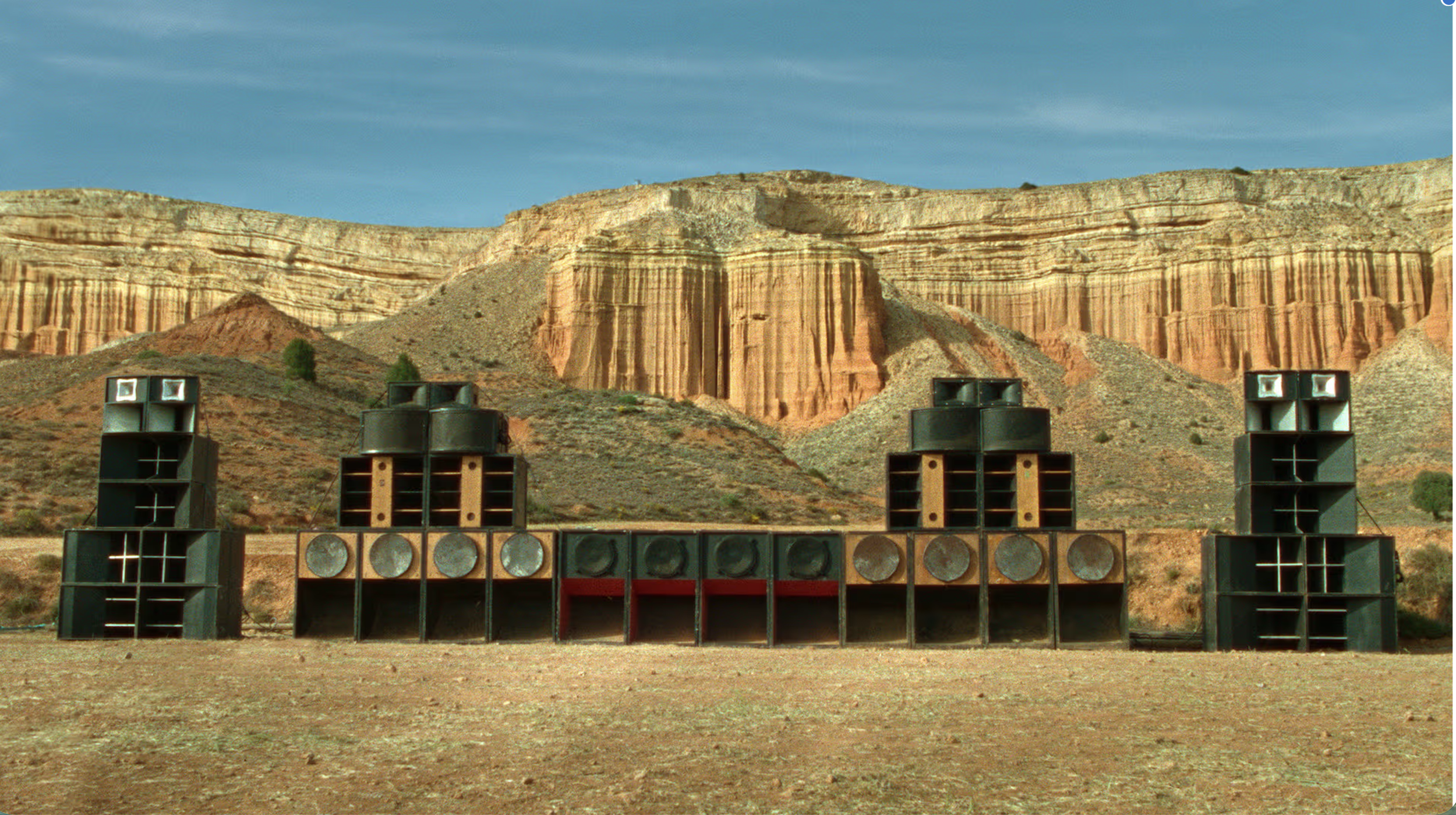
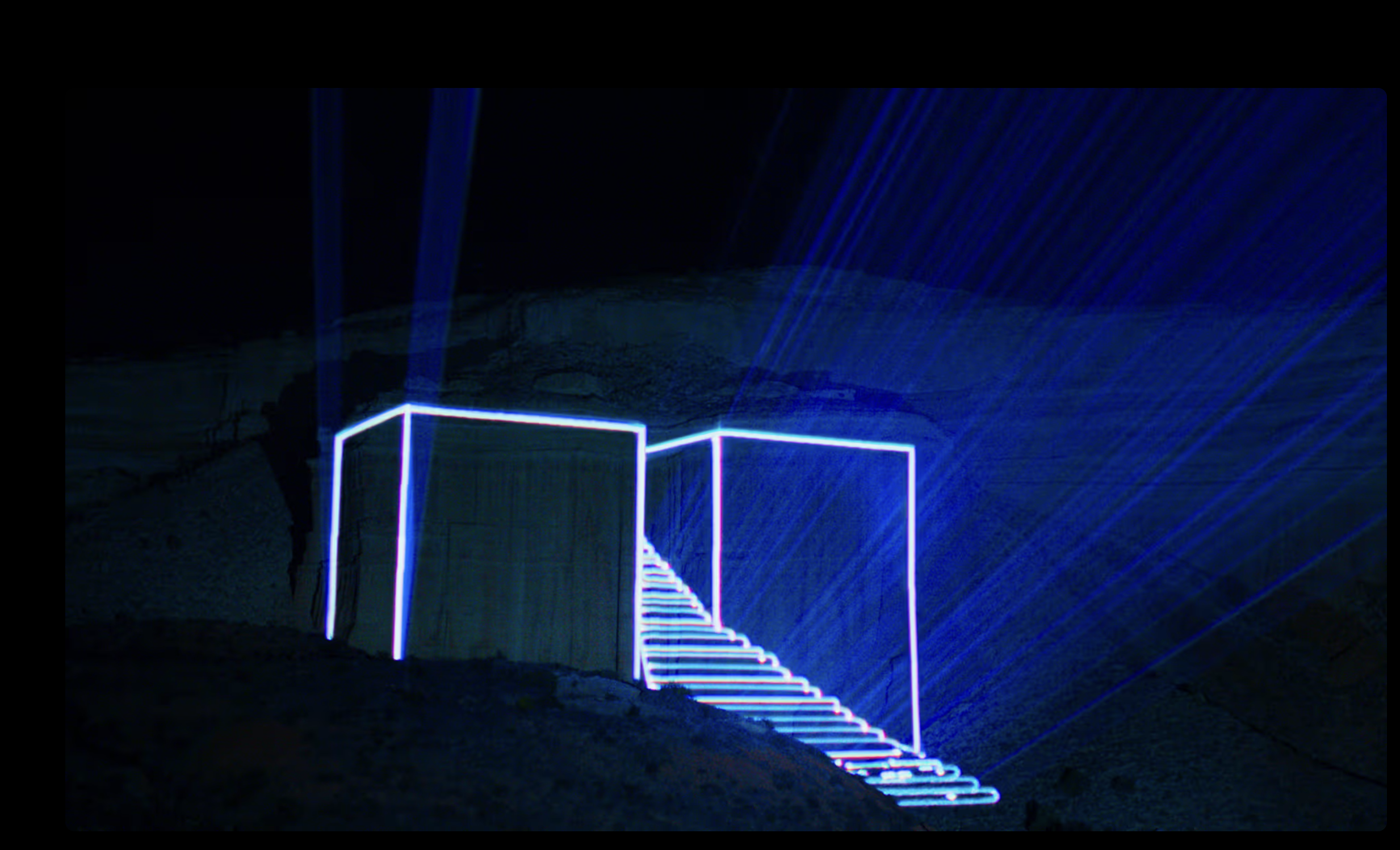
Oliver Laxe’s Sirāt begins with hands hauling and stacking a road-worn free-party rig — weathered speaker cabinets, cables, exposed cones, metal grilles —on a patch of desert ground between two enormous block-like hills, so steep and flat-topped that they seem less like landscape than architecture. The music begins to pulse; the bass strikes the rock faces and returns thickened by echo, turning the desert, a moment earlier indifferent geology, into an acoustic chamber. As night runs into morning, lasers carve the space between the hills into 3-D steps, a stairway climbing the gap. The first crossing the film offers is a false ascent, a virtual ladder to the sky whose promise depends on its own emptiness.
@ Neon
The speaker wall is the film’s first body. Shot close against the dark funnel of a cone, the speaker becomes an opening, an orifice, a mouth through which sound passes and around which bodies gather. The dancers press their palms against the cabinets, leaning toward them less as listeners than as bodies wanting to be taken up by vibration. In one early shot, a woman stands before a speaker whose cone is crossed by a cruciform steel bar, its mouth caught in a grid. The apparatus that makes passage possible is already barred. Sound still passes, but never cleanly; the call toward elsewhere arrives through obstruction.
Around this blocked mouth, the dancers appear as extremities before persons. The close-ups — a foot before a leg, a hand before an arm — do not simply fragment the body for visual intensity; they show how the rave has altered the body’s relation to place. Sound does not lift the dancers out of the desert so much as fasten them to it differently. Again and again, Sirāt returns to feet touching ground — bare feet, prosthetic feet, feet that dance, feet that later search for a safe line across earth. Against the opening fantasy of ascent, the film patiently builds another movement: not upward, but downward, into contact with the ground that will become both passage and catastrophe.
@ Neon
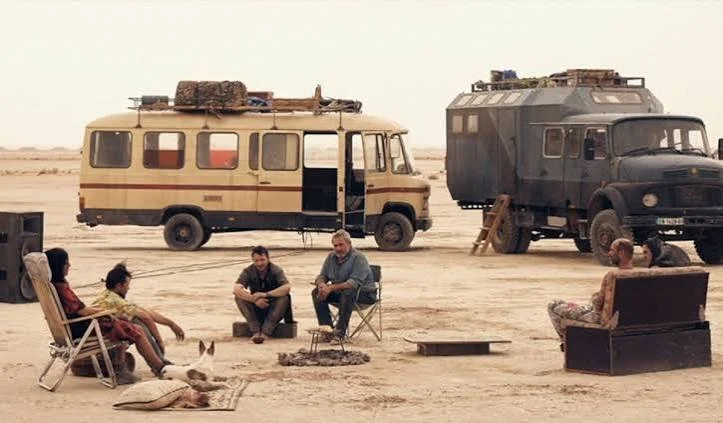
Into this scene arrive Luis and his son Esteban, carrying a photograph of Mar: daughter, sister, missing for months. They find a group of ravers resting after the night’s dancing — Stefania, Joshua, Tonin, Jade, Bigui — and ask whether anyone has seen her. The group is already a family, but an improvised one, organized around damaged but kindred bodies rather than blood, nation, or settled place. Tonin’s prosthetic leg and Bigui’s stump appear without explanation or pathos, as part of the collective’s ordinary condition of exposure. Because Laxe works with real ravers, the group feels less assembled than encountered — a social form already in motion. At first, they offer Luis and Esteban only the faintest lead. No one has seen Mar, but Jade tells them there may be another rave deeper in the desert. She might be there. That possibility is enough. After the military clears the rave, the private search is abruptly folded into a wider state of emergency: soldiers, borders, convoys, a war whose name will surface later as the Third World War. Luis and Esteban follow them into the desert, and what begins as a possible lead becomes a shared route through increasingly stripped conditions.
The cut that introduces the film’s second movement comes at a roadside shack, where Stefania enters and sees the Hajj playing on television. Hundreds of thousands of bodies circling the Kaaba, the imam’s voice carrying over the broadcast and then continuing, without a break, over the next image — a prosthetic foot setting itself down slowly on sand. Only then does the title Sirāt appear, naming the bridge joining hell and paradise in Islamic eschatology, a passage narrower than a strand of hair and sharper than a sword. The sacred passage is present, but at a distance, mediated by a screen, half-watched in transit. Hajj gives the film the form of passage it will undo. The pilgrim leaves ordinary life, enters the anonymous body of the crowd, and returns to a social order that can recognize the crossing. The desert journey keeps only the middle term: departure without return, liminality without reintegration, movement toward a party that may not exist and a daughter who may not be found.
The rave belongs to this suspended world, not outside history and not as a fantasy of escape from it. It is history’s afterlife, danced on broken equipment by people who already know the world is ending, or has been ending for a long time. Jade’s salvaged speaker is its material condensation: thrown away because it is broken, kept for the way it sounds — never the same twice, never guaranteed to sound again.
The film’s catastrophes turn this afterlife into ordeal. Esteban’s death is the first and most brutal lesson in contingency. On the morning it happens, he wakes in the car, plays with his dog Pipa, and is told by Luis to wait inside the car while they attend to the flat tire of the ravers' truck. The car is on a slope. The truck pulls forward. The car rolls back, over the edge, down. There is no omen to read, no hidden design, no moral architecture behind the event. The boy dies because of slope, timing, gravity, and a father’s ordinary instruction to stay put. The shock is pure accident: the very gesture meant to keep Esteban safe turns, without warning, into the ruin of Luis’s world.
@ New York Times
The ravers keep Luis from seeing Esteban’s body and take him with them in the truck. If Luis had first joined them by following Mar’s trace, he now remains because his own world has been stripped away. He is left with them as they have been left with one another: exposed, unsheltered, dependent on the provisional forms of care that damaged bodies make together. When they stop at a desert outpost, Luis walks away alone, straight into the setting sun, as if trying to follow his son across into death. He lies down with his arms out, offering himself to death, but the desert refuses him. The ravers find him, give him water, and sit beside him. Their witnessing consists in bodily nearness and the refusal to translate loss too quickly into speech. When Stefania says that someone will come to help, Luis answers that there is nothing but dirt here. He has crossed the desert trying to understand Mar’s disappearance, to discover what she might have been seeking out here. What he finds instead is dirt: not revelation, not explanation, only matter.
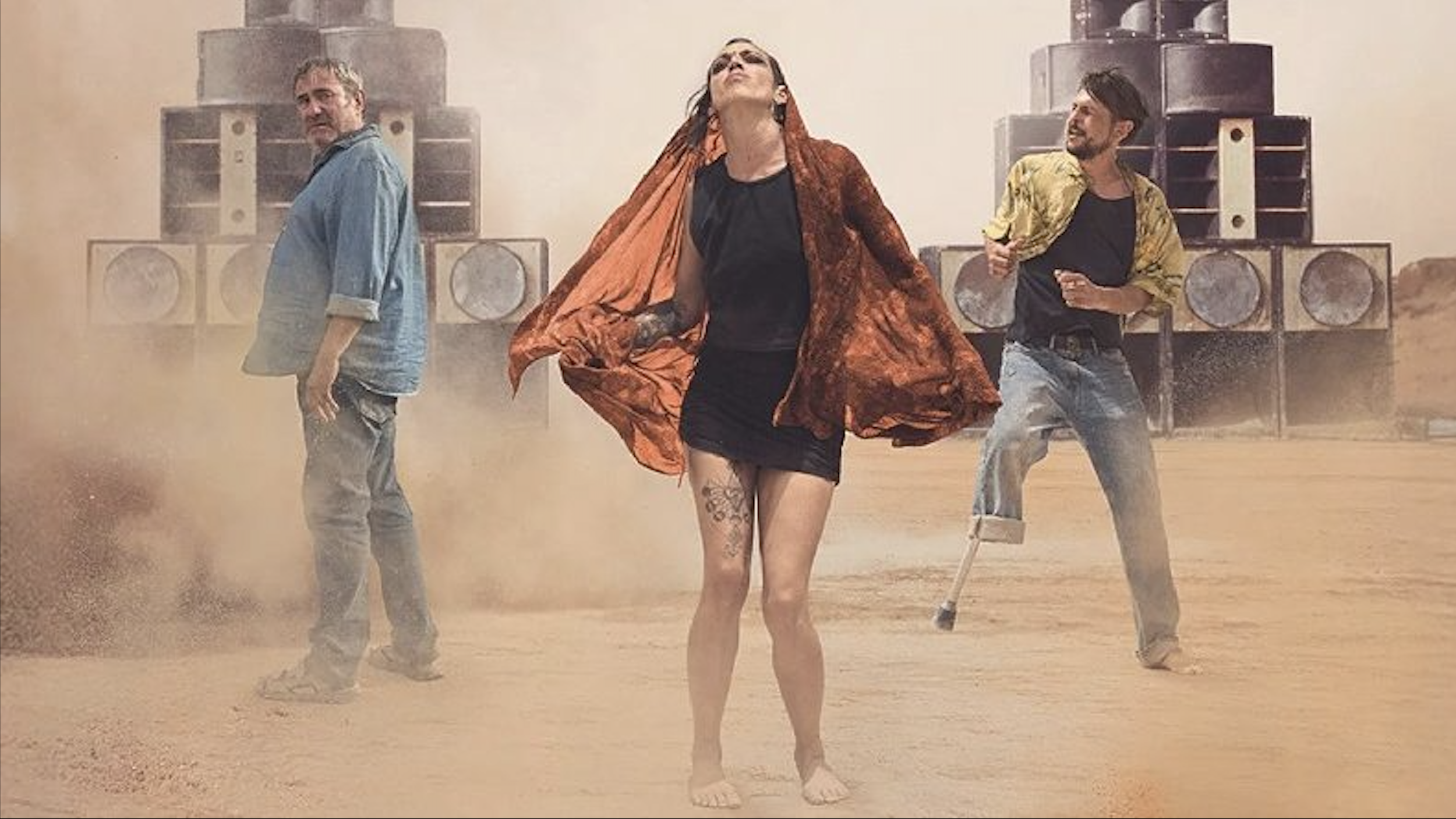
Later, at the encampment, the opening rave returns without its fantasy of ascent. Jade’s salvaged speaker is set up in the middle of nowhere, the hallucinogenic brew is boiled, and the dancing begins again; but now the film lowers its attention from lasers and rock to the body’s points of contact with the elements: feet pressing sand, Bigui’s back under the sun, the cloth of Jade’s veil undulating in the wind, Luis looking down at his own hands as if they no longer quite belong to him. The scene gathers the film’s recurring images of bodies given over to the elements and brings them to their highest intensity. Jade shouts for the sound to be turned up and the phrase–"Blow it up!"--is still party-language, a demand for more volume, more force, more collective transport. Then the ground takes it literally. A landmine explodes. Tonin runs toward Jade and is taken too. The trucks sent forward to force a path are blown apart one after another.
Jade’s death opens a different order of accident than Esteban’s. His death was contingency without design; hers is contingency produced by a design that has disappeared from view. The mine is a made thing, a decision placed in the earth and then stripped by sand and time of its visible marks until it can strike with the appearance of chance. Once buried deeply enough, violence can return as if it were nature. The desert appears to offer only elemental indifference, but it is littered with decisions. In its etymological sense, disaster names a bad star; here, the disaster does not fall from the sky but rises from underfoot.
Stranded in mined ground, Luis says their only chance is to reach the rocky rise ahead. He walks without thinking and survives. Then the wind erases his tracks. Bigui tries to follow anyway, placing his feet where Luis’s feet had been, and is blown up. The Sirāt takes form here not as an allegory imposed on the film, but as the structure of the passage itself: it must be crossed, and yet it cannot become a path. A path can be repeated, taught, handed on. This crossing cannot. Bigui dies because he tries to make another person’s crossing into a method.
Stefania and Joshua find another way. They do not move with Luis’s frightening certainty, and they do not imitate the vanished track. They close their eyes and cross together, breathing one step at a time, with their dog held in Joshua’s arms. What carries them is not sight, which would only search for a path that no longer exists, but the trust of moving without seeing, held between two breathing bodies. They survive not because they know the way, but because they give up the fantasy that the way can be known.
@ Lincoln Center
At the top of the hill, the gate from the opening has finally been crossed, but the other side offers no arrival. It opens onto another valley. Looking back, the death-ground is already small; distance has begun to turn catastrophe into landscape. Then the film fades the survivors into the mouth of the speaker, the cone that has been calling out and calling in since the first frame. The promised beyond lies on the other side of that mouth.
What emerges is not paradise, but a train. It cuts across the desert with hundreds of migrants riding on top, faces wrapped in cloth, bodies exposed, anonymous. Stefania, Joshua, and Luis are there too, no longer gathered as the small family that crossed the minefield, but dispersed into the mass of the unwanted. The mouth that seemed to promise transcendence opens onto history’s plainest freight. The Sirāt has been crossed, but the far side is not salvation. It is movement without refuge, across the Moroccan desert and the contested geography of Western Sahara, along the routes by which African migrants are carried, stopped, redirected, or abandoned at the thresholds of Europe. The film’s final line is therefore not only metaphysical but geopolitical: Morocco appears as passage and barrier at once, a transit zone where old colonial lines, the unresolved status of Western Sahara, and contemporary European borders continue to organize who may move and who must remain in motion. From the hill, they looked back and the dead receded. From the train, they look forward and there is only track. The crossing is over. What remains is more line.
2+2=5: part of our practice in creating STARLING is to allow for the 4 things gathered here to spontaneously generate a 5th thing. This month’s 5th thing is the titular poem Indigo, by Ellen Bass:

book cover, Copper Canyon Press
Send STARLING to a friend!