M Acuff + Özge Serin
STARLING is a monthly electronic missive co-authored by Özge Serin and M Acuff. You’re receiving it because we thought you’d like it. Our desire is to craft a series of short offerings, of things we’re into, have found enthrallment with, or are just mulling over. Our musings engage with things new and old, local and at a far remove, spatially and temporally; against the daily deluge of stimulus these are a few items we are holding close.
This name STARLING implies a community of synchronous correlated intelligence and more-than-human wisdom, which we are imagining into being.
We hope you will enjoy!
Film of the Month - Is God Is:
Note: This month, I veer from my usual film reviews. After watching Aleshea Harris’s film adaptation of her play Is God Is, I felt compelled to return to the play, where the typography itself began to seem cinematic: words stretch, scatter, reverse, and move across the page, producing forms of duration and movement that the film cannot simply carry over.
Two Black girls, twins in their late teens, introduce themselves in the third person. Racine is the rough one who still has some pretty to her, scarred across the back and a little up the neck where it can barely be seen; Anaia’s face, they say, looks like it melted and then froze, and mostly people refuse her gaze. They have already converted the asymmetry into character: the ugly one is held “in a prison of sweetness”, so the other one carries “both their mean” (p. 25).
What these two have in place of an outside is each other—a mirror that is a duplicate, difference held to the minimum of temperament and marking, and a shared vocabulary in which each recognizes and speaks the other into existence. It is a closed world with no third term in it. The only name they use for one another is Twin. The form their bond takes is ice. The scars have not finished burning, there is fire still in them trying to get out, and what the sisters do for each other is press the cold into the marks—the literal cold for a literal heat, and the idiom for cooling a temper, the two senses left unranked. No interior is addressed. The one tenderness in the play is applied entirely to the surface.
A letter breaks their world open almost immediately. It comes from a woman they had been told was dead, whom they find on her deathbed in the “Dirty South”, attended like a court, veiled and beaded over the burns their father inflicted when he set her on fire before them, in the same blaze that marked their own bodies. She had let them believe she was dead rather than have them keep a mother who looked, as she says, “like uh alligator” (p. 39). Now she wants him killed. Peace will come when he goes, the violence returned to the one who began it and the circle closed. The daughters hesitate—they are not killers. Racine suggests forgiving and forgetting—until the mother has herself uncovered. The burned body becomes the final argument and the daughters say yes. Nothing in this play can answer back to a wound.
The text calls her SHE, not mother, and God is the daughters’ word rather than the play’s. They infer divinity from making, and even that inference arrives as a question: “she made us, didn’t she?” The title holds the same ambiguity. Is God Is carries two copulas in an idiom that ordinarily deletes the verb of being—the play’s own speech runs she dead, he dead—and neither half completes: a question with no predicate, an assertion with no complement. Whether God is at all, and what God is, are both left standing. What the task requires, in any case, is not a maker but a sanction, an authority behind the act that can convert revenge into fidelity. Racine supplies the formula: they are nothing but the hand of God doing Her bidding.
Once they accept the command, the sisters head west toward the father and the second family he has made in the California desert—a wife and another pair of twins, boys this time, a second household, “big yellow house with them teal shutters,” uncannily repeating the first in displaced form. Where the first survives as fire and marking, this one is housed, paternal, legitimate, only to be destroyed in turn. The repetition already unsettles any straight line of descent. In the play, another kind of line comes into view: the line made visible by typography itself.
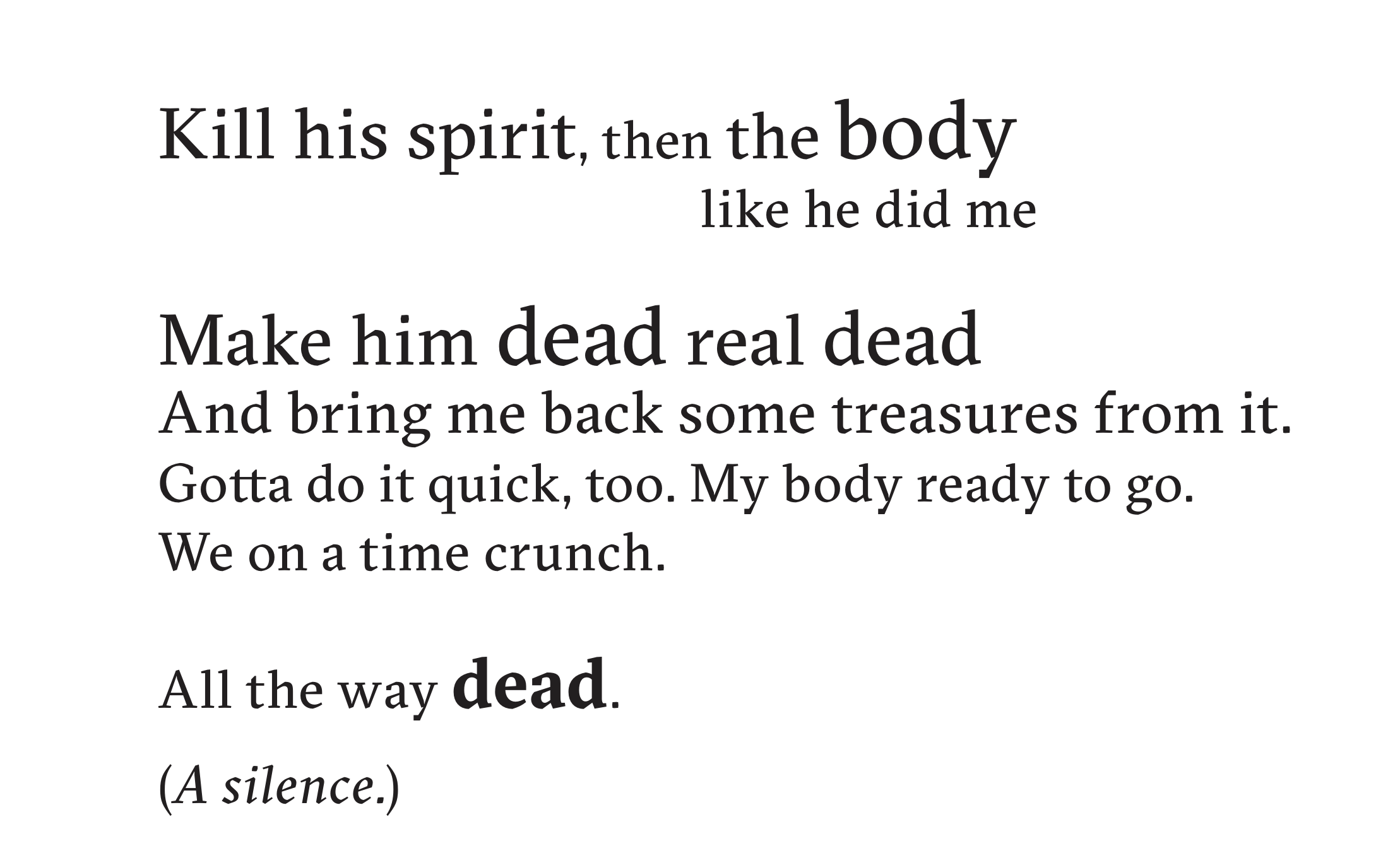
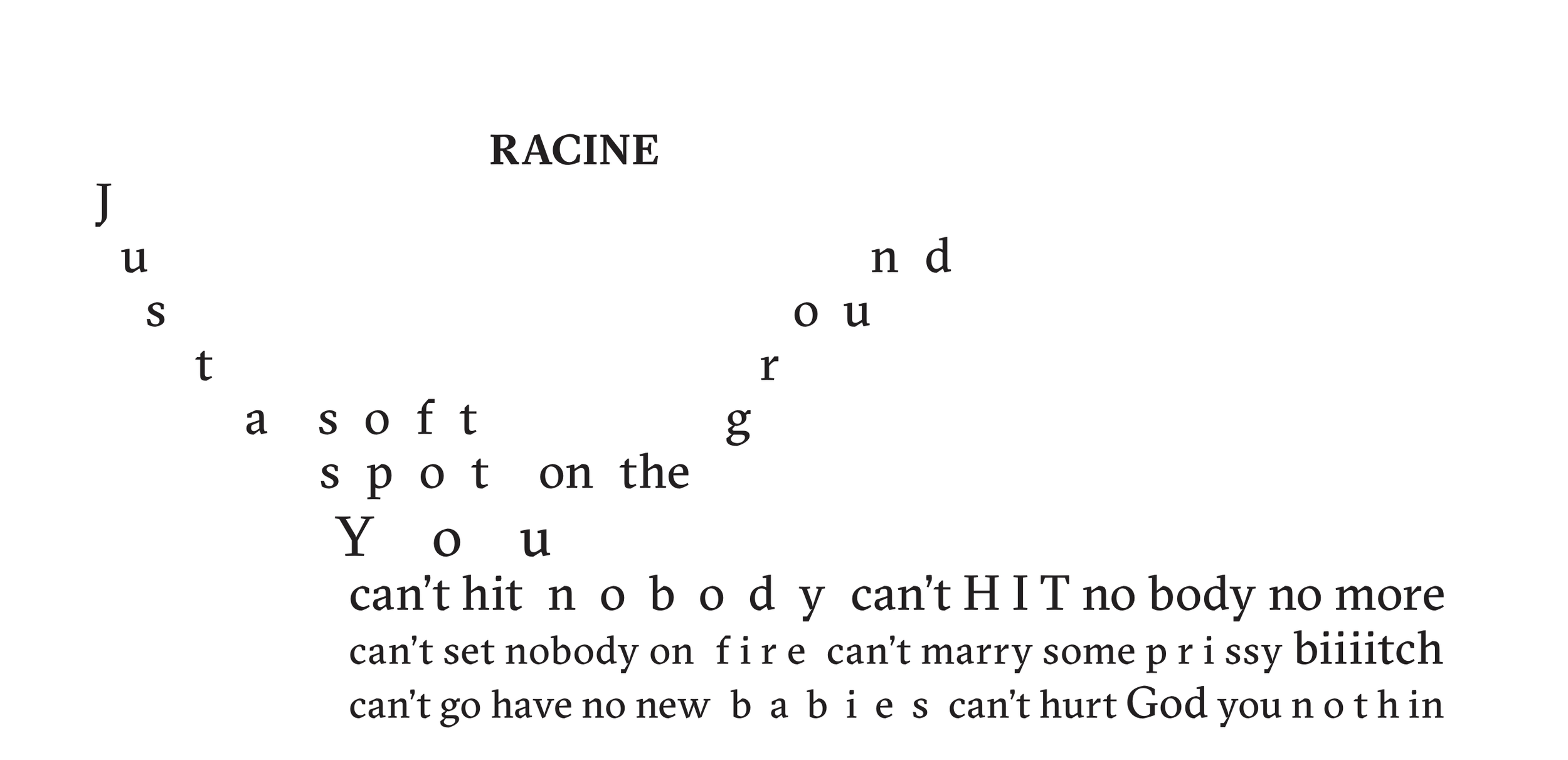
On the page, letters stretch apart; words scatter and interleave; capitalization migrates; language visibly turns on itself. Their passage into performance makes clear that these arrangements are not instructions with fixed equivalents. Harris leaves actors to decide what a change in size or spacing might do. Performers have treated typography as a scale of intensity, altering volume, rhythm, and pronunciation, or deliberately playing against the intensity the page appears to propose. Stage productions have extended its discontinuities into abrupt shifts of light and sound. The film disperses the same problem across another visual field, giving the twins’ silent exchanges written form on screen and using split screens and editing to fracture and recombine their relation. But none of these translations simply reproduces what the typography does in reading. On the page, spacing, scale, and arrangement act directly on duration and pressure: the eye is held, accelerated, interrupted, forced across gaps. The word becomes a site of affect—a passage in intensity rather than the representation of an emotion—and the line acquires force of its own: it can scatter, expend itself, or turn.
By the time the MAN arrives, the sisters have already killed his wife and twin sons with a makeshift weapon, a rock knotted into a sock. Anaia, pregnant, faces him amid the remains of the second household, while Racine lies unconscious nearby after the surviving twin attacked her in retaliation for killing his brother, who had called Anaia ugly. The MAN tries to talk his way out of the scene: SHE lied; the story of the fire is not the story; Anaia is prettier than the woman he burned; and if she lowers the weapon, the child she carries—his “first grandchild”, his stock—might someday sit on his knee while the blood on the ground is “brushed away like a cobweb” (p. 122). Explanation, analogy, and the conditional lend violence the form of reason, while paternal descent supplies its promised future. The ruse works. Anaia lowers the weapon. Then he attacks her, and the language that had covered violence as argument gives way to cruelty without cover. On the page, the words themselves scatter and interleave, until what had moved syntactically through reason and futurity breaks apart graphically as force.
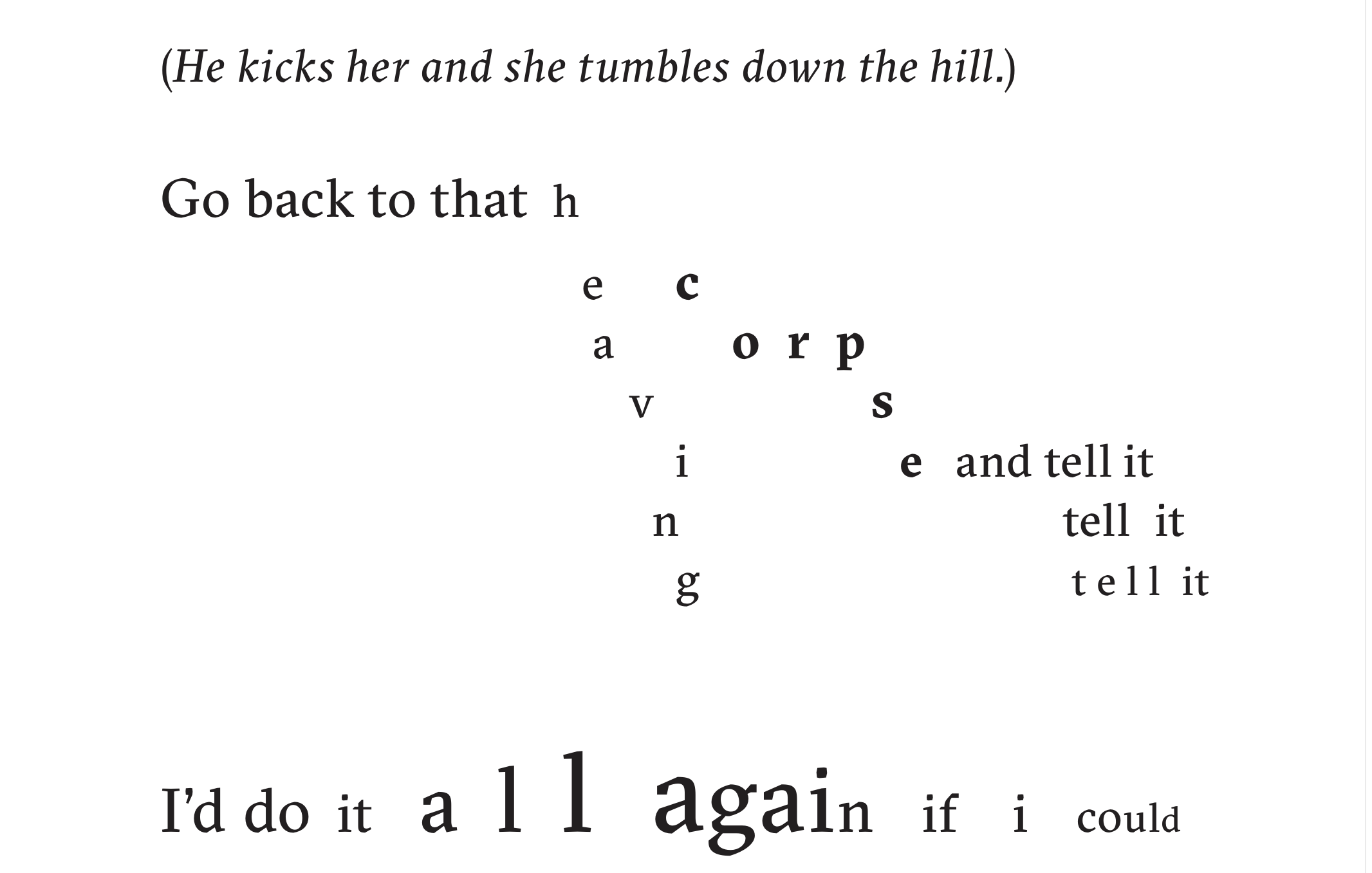
The twin sisters submit the father’s body to an analogous deformation. The Man who has invoked stock, grandchild, futurity—the vertical line of paternal descent—is brought down, held to the horizontal, and told that he is nothing. Their pleasure attaches not simply to killing the father but to destroying the position from which he claims lineage, authority, and futurity. The vertical figure is pinned flat against the ground, reduced to “NOTHIN.” Parricide becomes almost typographic: the paternal line is struck apart on the page and rendered horizontal in the body.
What descends in this family is neither a name nor an estate but a burn. A genogram could plot the relations among its members, but not the different forms taken by what passes through those relations. Descent alone cannot distinguish repetition from displacement, expenditure from deviation.
Deleuze gives these different fates of the line a formal vocabulary. The circle returns to its point of origin; the spiral repeats by displacement. Against these organic lines he sets the non-organic line, which may regain force by changing direction at an obstacle or lose itself like a line disappearing into sand. The father’s is the latter. In Freud’s primal parricide, the murdered father returns as law; guilt curves the line back, and out of the return come prohibition and social bond. Harris draws every element and withholds the curve. The band is sisters. They act not from desire but on a commandment that precedes them. Afterward there is neither guilt nor elevation. No paternal name follows his death. The line goes into the sand. Dissipation here is not a fading but a total expenditure that leaves nothing behind it.
The spiral traced by the two households makes one final turn at the MAN’s death. They set him on fire, and as he burns he takes hold of Racine and she burns with him. The fire with which he destroyed the first household returns at the destruction of the second, but catches one of the daughters it marked the first time. Racine does not die in a movement of her own; she is drawn into his, the last stroke of a figure he has been drawing since the first fire.
Her sister is dying and calling for her, and Anaia does not save her. She answers: “i. i can’t, Twin.” English marks the first person with a capital letter, and Harris withholds it: the self arrives twice, lowercase, at exactly the moment the pair comes apart and Anaia has to speak as one. Then she turns the word itself: “t’naC.” A reversal of sense would have produced can, making the refusal a declaration of capacity; instead, the word for incapacity is worked as material at the moment it would have committed her. She neither declares herself unable, which would make this a limit she suffers, nor declares herself choosing, which would make it a decision she owes an account of. Anaia’s is the broken line: it meets the obstacle and changes direction rather than continuing through it, and the turn is an increase rather than an expenditure. Only then does a capital appear, displaced to the end of the turned word, on the letter that ordinarily begins it. What is raised here is the swerve, not the one who makes it.
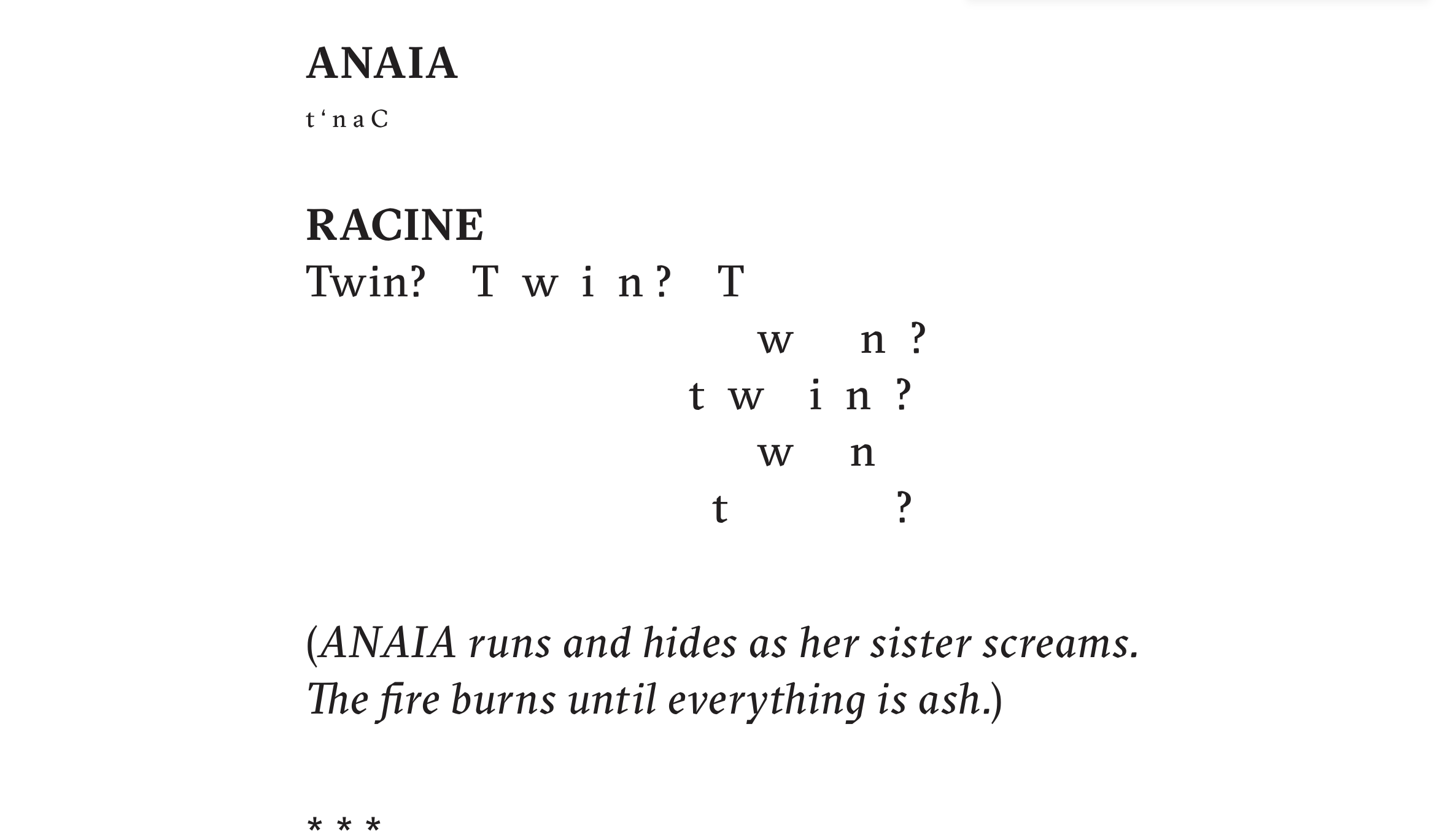
Returning to the dying SHE to tell her the deed is done, Anaia announces the child’s name: Enica, almost her sister’s name spelled backwards. Racine is the French for root, and what falls away in the near-reversal is the root’s own first letter. t’naC and Enica are made the same way, and differ only in what becomes of them. The first is an event—spoken once, over a burning sister, suspending sense without replacing it. The second is name-shaped, and a person will carry it. The swerve does not terminate transmission; it changes what transmission can carry.
Then the rock goes up over her mother’s head, and it is already in the air when Anaia asks whether they are cursed. This is the question of the ventrem, put by a pregnant woman to the body she came out of, about what her own belly will carry, at the one moment when an answer might settle what she does next. The mother says it is “hard to say,” and that uncertainty cuts against the juridical certainty of partus sequitur ventrem, which made the child’s status follow that of the mother, turning reproduction into the reproduction of enslavement itself. Harris has already given such transmission a terrible corporeal form: the violence done to the mother returns as scar on her daughters’ bodies, and when Racine asks what lies beneath Anaia’s scars, the answer is nothing but death—no body in reserve beneath the marking, no person recoverable by removal. The swerve offers no fantasy of escaping what has been transmitted; it opens another question, whether transmitted violence determines the form of its repetition.
What Anaia has instead is her own report of feeling—the curse registered as intensity, never promoted to a proposition. The mother reports a quiet, stretched letter by letter across the page; the daughter answers that she still hears noise. Then a lullaby enters, almost imperceptible, sung by nobody and inaudible to the woman who has just declared silence. Like the ice the twins press into each other’s scars and the beads worked over the mother’s burns, the lullaby tends without commanding. Maternal care is finally detached from maternal commandment, and it is this separation that disarms Anaia. She lowers the rock.
The film, which Harris wrote and directed herself, never returns Anaia to the SHE. It ends instead with a woman holding her child and looking at the sky. The child is unnamed. What stands at the end instead is the organic figure at its plainest: a mother, an infant, a closed world of two reconstituted, a vertical axis restored in a work whose God had been a burned body in a room and not anything one looks up toward. The circle closes.
What it closes over is the swerve, and with it a particular inheritance. Enica is not the sister’s name and not a new one. It is what is left of a turn performed on that name, offered as almost, missing the letter the root began with—so what the child receives is neither an ancestor nor a fresh start but the trace of a deviation, the one thing in this play that was gained rather than spent. The family line continues, but only by ceasing to be straight.
You can purchase a copy of the play here.
Rock Solid:
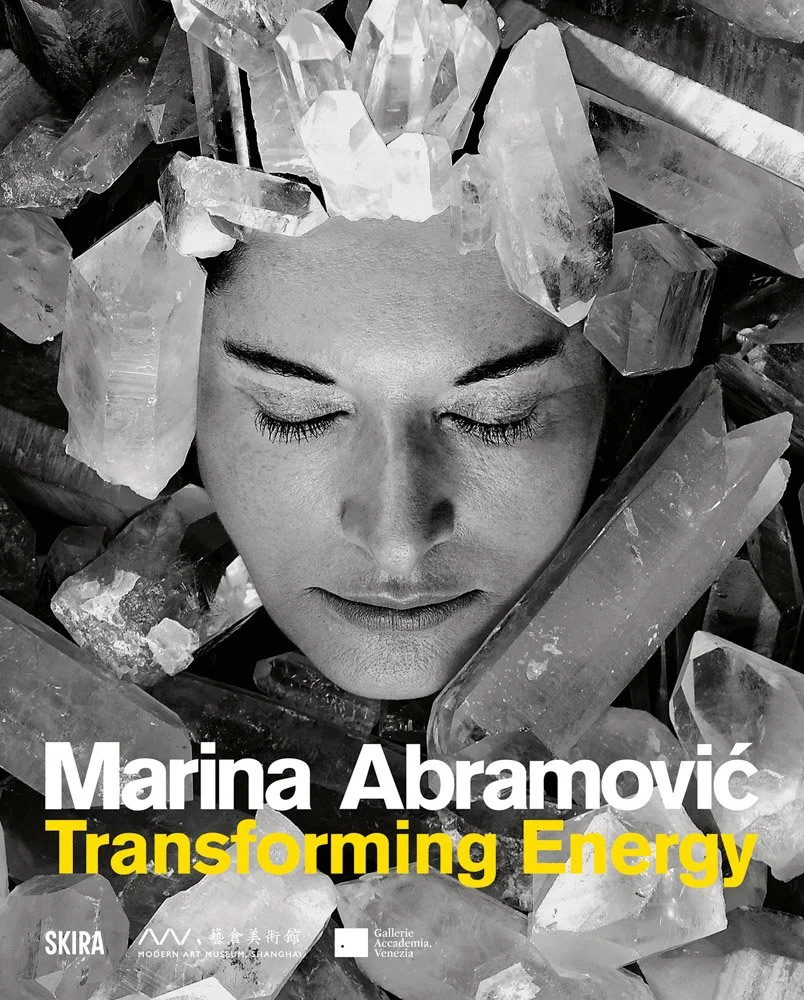
While in Venice earlier this summer I had the great fortune of being able to see Marina Abramovic’s show Transforming Energy at the Gallerie dell’Accademica. I honestly wasn’t super familiar with her work involving crystals–which has been happening for decades–like many others I was captured by the performances that involved danger, actual and implied violence, and her signature preternatural psychic presence. But her works with crystals draw from the very same wells of inexplicable endurance and otherworldly insight, while at the same time being so very quiet.
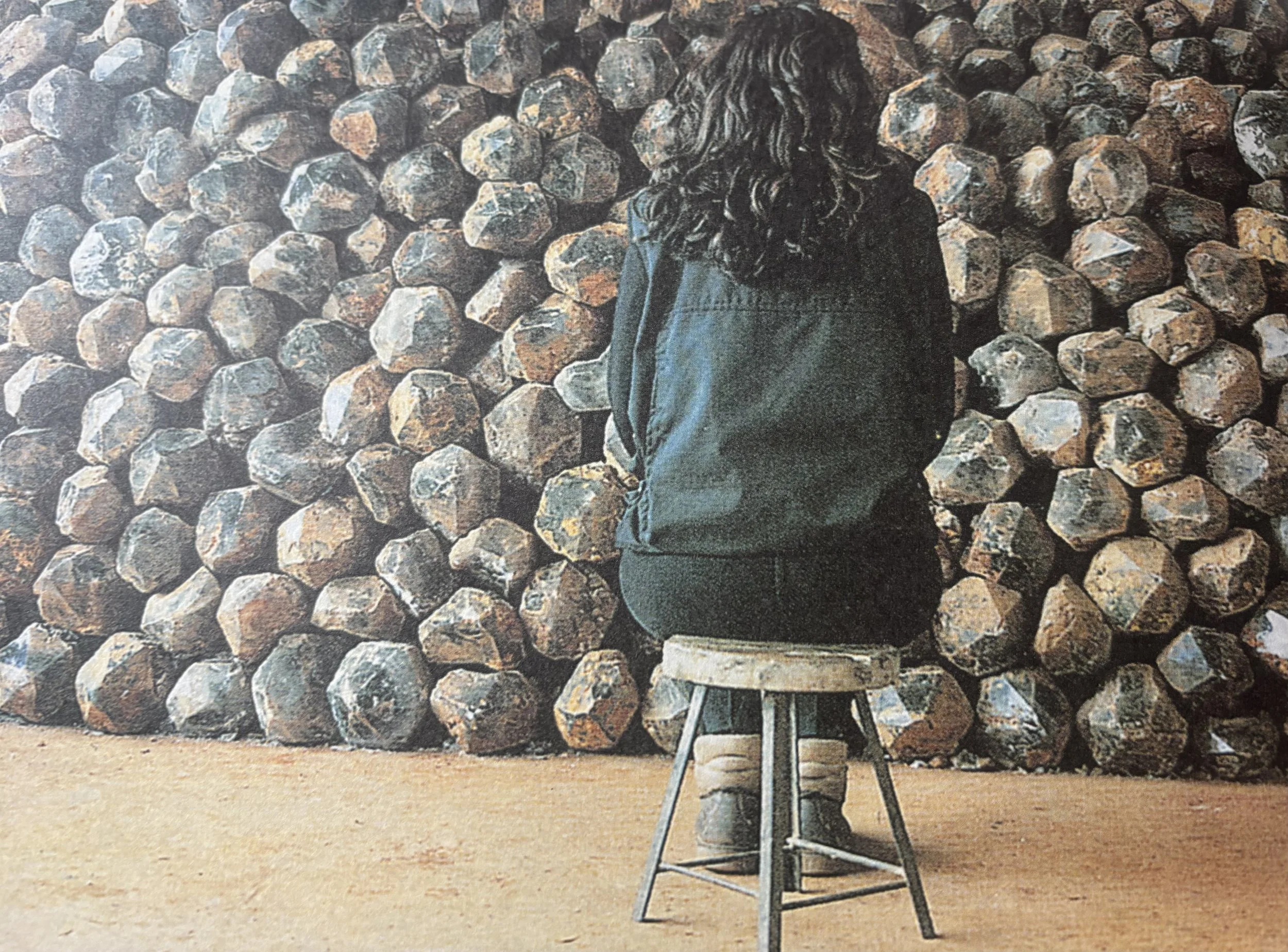
Marina Abramovic, Waiting for an Idea, 1991
The show was full of crystals–works that you could stand near, press against or even lie down upon, all of which I did, but my two favorite pieces (pictured here) are from the early 1990’s. These works struck a chord in part due to the recent NYT article about the results of an experiment in which chimpanzees were given various sizes of rocks, some mesmerizing crystals and others opaque sandstone. (Thank you JCP!) The working hypothesis was that crystals have acted as a template for geometric thinking and offered our ancestors the material spark that ignited abstract, symbolic thought. Unable to test this theory on our actual forbears, the scientists chose the next best thing, our nearest relatives–chimps with whom we genetically parted ways about 6 million years ago. Long story short, the chimps were immediately enthralled with the crystals, in stark contrast to the sandstone, about which they gave a flying fuck. So much so that the scientists had to bribe the chimps with ungodly amounts of bananas to get the largest crystals back. Many of the smaller crystals used in the experiment were not located again.
[One needs little proof that our appetite for dazzling light-imbued structures has yet to be sated, evidenced by the mere fact that you are now staring into a "postmodern crack pipe” to read these words.]
The titles of the two works, Waiting for an Idea and Crystal Cinema I, are provocative enough. In one, Marina sits facing a wall of unpolished loave-like crystals. In the other she squares off on a squat stool opposite one particularly narrow and pointed orb that appears to return her gaze. I find the contemplativeness of the images heartening and also a deft tonic. I identify in particular with the notion that making is an internal, almost invisible act, requiring at times inactivity as much as its opposite. Following Abramovic’s lead, I am also increasingly trying to “attune to the earth”–this complex literal and figurative ground from which all roiling multitudinous consciousness springs, but with which we have a mostly extractive, omnicidal, instrumental relation.
Most of all these images are for me a kind of rejoinder to, a turning one’s back on, the image and material substance of increasingly ubiquitous cementine and steel AI “data” centers. Abramovic offers a raw antidote to the corporate monoliths and monuments to so-called intelligence that are currently colonizing the landscape and our attention.
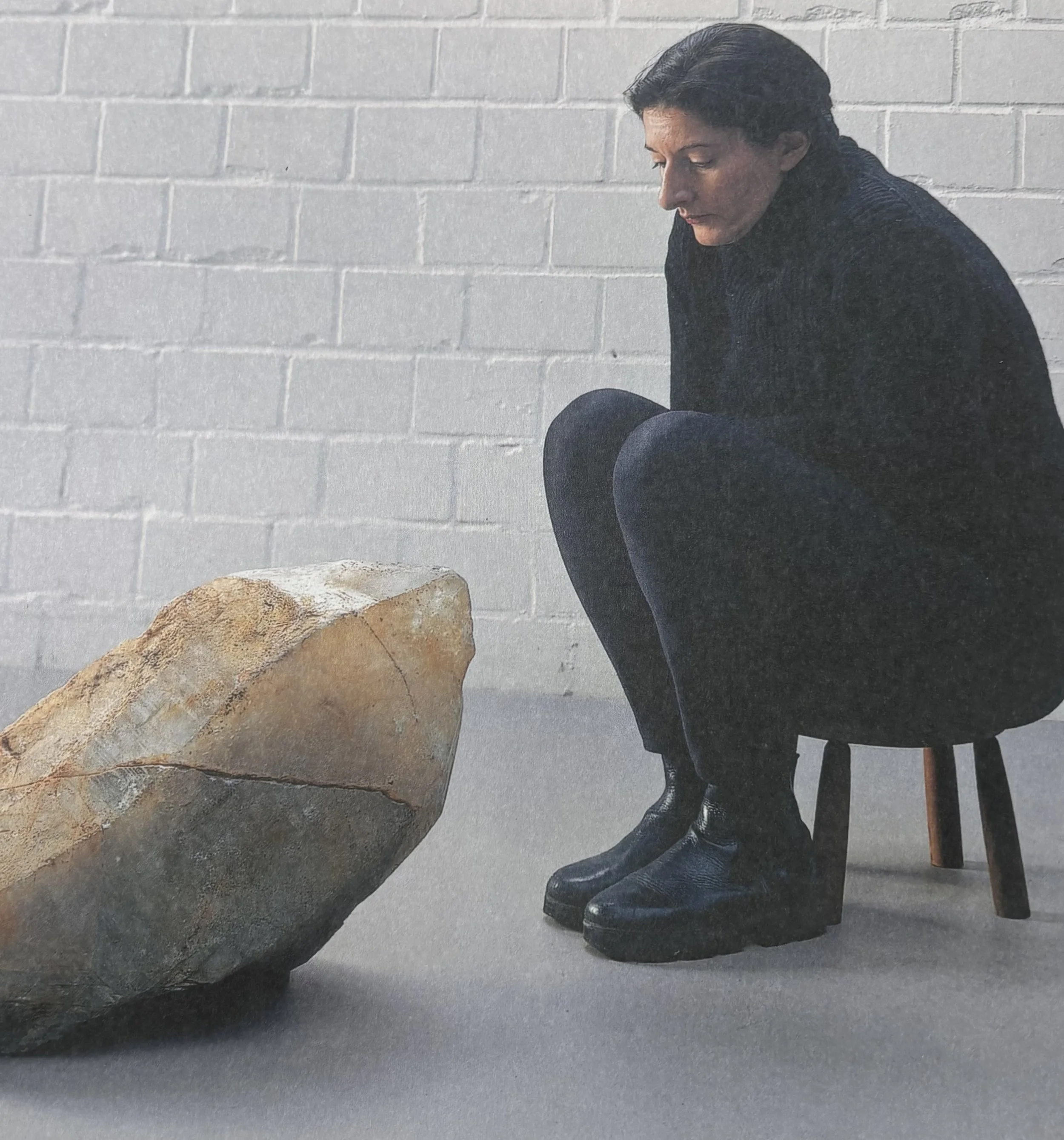
Marina Abramovic, Crystal Cinema I, 1990
Reverie #5:
A body crosses a room, a bird flies across a field, someone walks through a city. What if movement is not simply something that happens in a world, but the way a world changes? For Bergson, as Deleuze reads him in his cinema lectures, duration cannot be equivalent to movement which is merely translation from one place to another. Duration is not the time it takes to get from here to there but what changes—the qualitative transformation of a life, a situation, a world. Movement expresses duration when what happens in space makes perceptible a change that cannot itself be reduced to space.
Deleuze finds a beautiful example in Billy Wilder’s The Lost Weekend. An alcoholic walks through the city. Taken literally, very little is happening: a man is displacing himself in space. But we do not experience the walk merely as a succession of positions. We see someone running to his doom. The movement of the body has become the expression of another movement that cannot be mapped in the same way: a life coming undone. We cannot see duration itself as though it were another object in the frame. We see it through movement. The walk gives a visible trajectory to an invisible transformation. Cinematographic perception can therefore make time sensible not simply by showing that things move, but by making the continuity and heterogeneity of one and the same movement bear the pressure of what is changing.
A frame cuts out an apparently closed world; a shot gives the things within it a movement; but neither, by itself, gives us the Whole. The Whole is not the sum of everything contained in the image. It is the Open: the real time in which things are becoming other than what they were. Montage is the cinema’s way of bringing movement into relation with that changing Whole.
Different traditions discovered different ways of making perceptible a world that does not remain the same. Soviet cinema finds it in collision: one movement presses against another and something new flashes from their encounter. French cinema finds it in quantity and rhythm, movement gathering, accelerating, slowing, multiplying until the image seems to exceed itself. German Expressionism finds a much darker and stranger solution. It turns from the opposition or multiplication of movements toward their intensity.
Heat, brightness, terror do not increase as a line increases by adding centimeters. An intensity is experienced all at once as a degree and therefore as a distance from zero. Every intensity secretly bears this zero within it, a virtual possibility of falling away.
Expressionist cinema finds this intensive dimension of movement in light: every luminous state leans toward darkness, every form toward the point at which it can no longer maintain its form. The straight line buckles. The house tilts. The face becomes strange to itself. Matter seems to loosen, sink, "slosh." Expressionism discovers life precisely here, not in the integrity of the organism but in the unsettling vitality of things, a “non-organic life of things,” as they decompose.
Decomposition need not mean ruin. In Deleuze’s wonderfully simple formulation, something is created through something that comes undone. Once a composition loosens, its elements enter other relations; what had been held together one way becomes available to be composed otherwise. Decomposition is therefore already a kind of recomposition—not because what is lost is restored, but because undoing is itself productive of new relations. The movement toward darkness and the movement toward creation belong to the same duration.
Perhaps this is what makes decomposition such a compelling image of change. We tend to imagine transformation as one completed form giving way to another: before, then after. Duration suggests something less orderly. The new does not wait politely for the old to disappear. It takes shape in its loosening. What is decomposing and what is becoming coexist. The Whole is not the stable world that contains these changes; it is this ceaseless changing itself—the trembling passage in which a world, a body, a life is no longer quite what it was, and not yet what it will become.
Earth Studio:
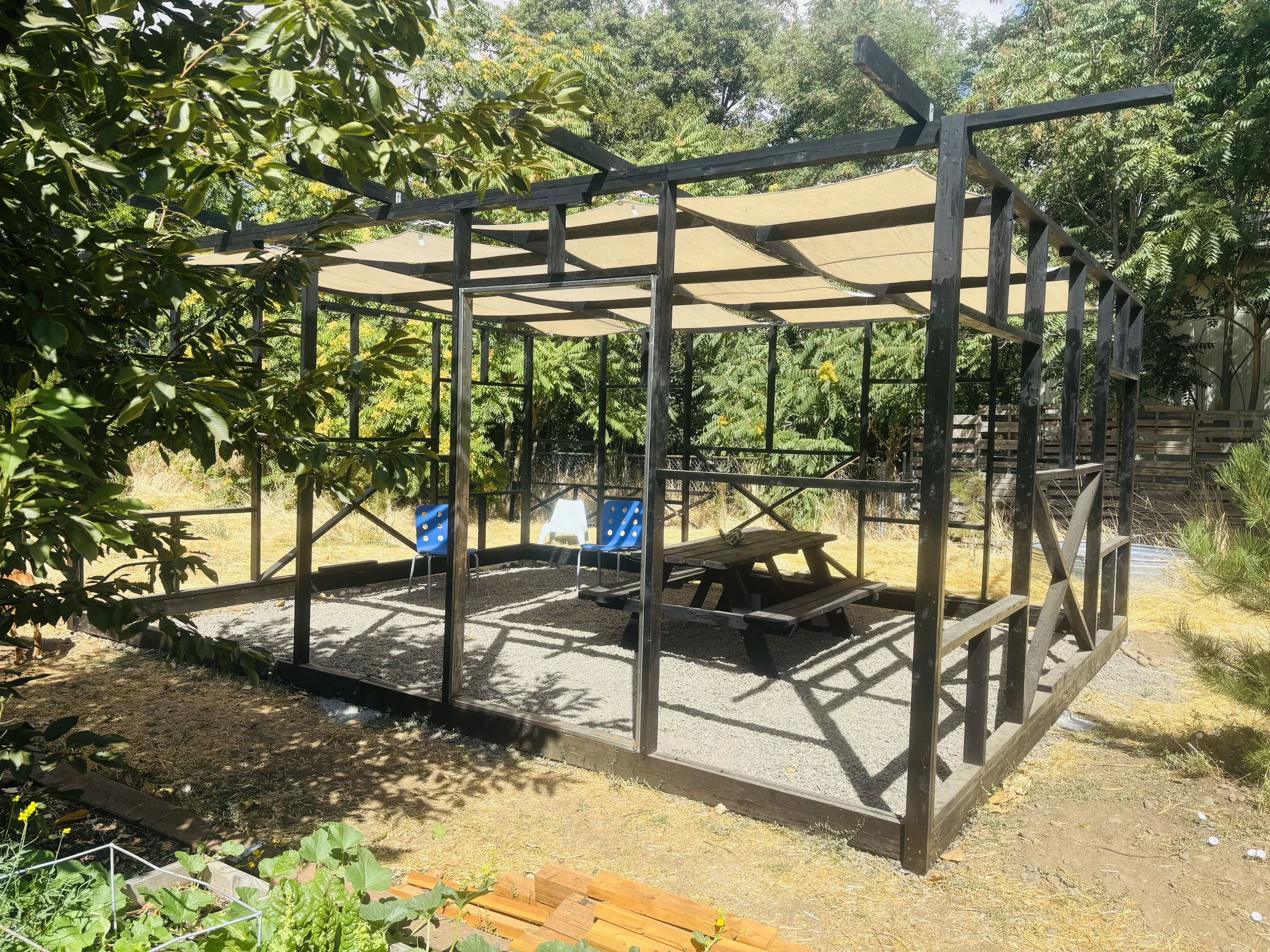
Earth Studio, 16x20x8’, pine, steel, stain, canvas, gravel
One of my summer projects has involved the construction of what I have come to call an “Earth Studio”. This relatively simple structure was at first patterned a vernacular shed form: a practical delineation of space with a roof to provide shade. Riding a fast train around Italy gazing at architectural marvels designed by the likes of Brunelleschi and Renzo Piano transformed that original idea into something more classical, attenuated, and hopefully more beautiful than pragmatic.
The movement from paper sketch to the real world involved several surprises. (Apparently I build buildings with the same logic I use to make a sculpture: no blueprint, just a vague intuition about proportion and physics.) With the help of Ben Selby we soon had a lofty, top heavy, wobbly beast on our hands and had to recalibrate. We reduced the height, strengthened the intentionally minimal framing with cross braces and steel and experimented with a canvas roof. The entire project morphed, but at this point I was hooked and had a vision. I was in love with the geometry, the site (adjacent to the garden and near to the creek) and the idea of an eventual earthen-cob floor, hence the name: Earth Studio. The walls will remain toothpick thin and unclad, permitting nearby cherry, pine, and apricot tree branches to intermingle with the structure itself. Sculpture? Building? Tool? Some blurring of these. I have a hunch that it’s as much a device for making, thinking, being, as it is the location of facture.
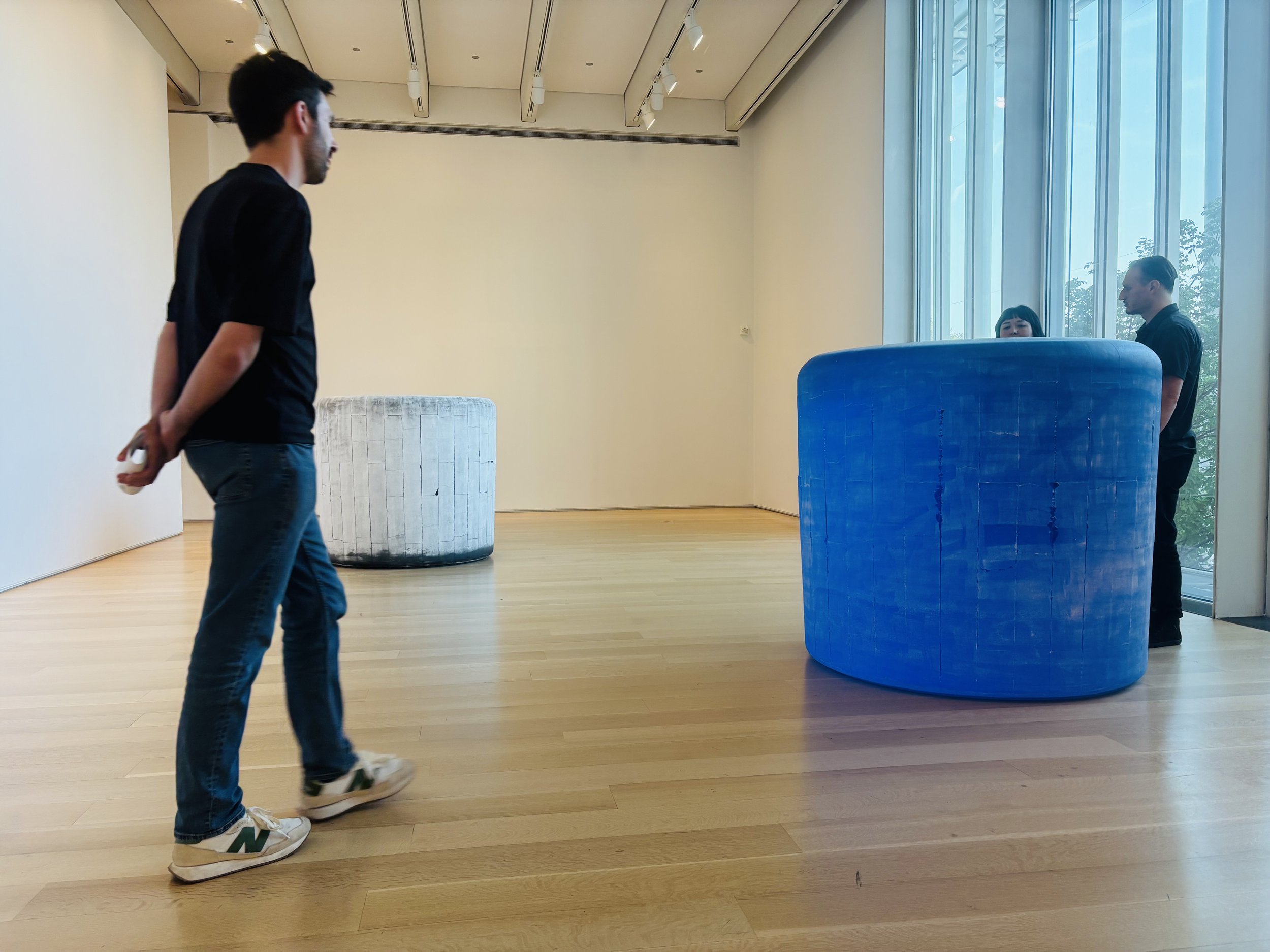
2+2=5: part of our practice in creating STARLING is to allow for the 4 things gathered here to spontaneously generate a 5th thing. This month’s 5th thing are these solid glass sculptures by Roni Horn that we visited with @ The Art Institute in Chicago. According to the artist statement, Horn says it takes months for the molten glass to cool down after it has been pored into the molds. Technically glass is neither solid nor liquid, but always hovering somewhere in between. The outside of these works are textured from the imprint of wooden mold boards, but the top is pure polished glassy magnificence. One is actually not allowed to hold a phone above the works in order to take a photo, in the event that you drop your camera onto the surface and thereby mar it. Of her works with glass, Horn says, “When you stand by … any body of water—an ocean, a lake—there’s a whole history of reverie that clicks on … . Rather than an object, water becomes a form— of consciousness, of time, of physicality, of the human condition, of anything I desire to project on it, of anything I want it to be.”
Send STARLING to a friend!